Collecting guides
How to Identify a Vinyl Pressing… and When to Stop Trying
Updated · Published
Identify a vinyl pressing by comparing the catalogue number, label, sleeve and runout. A practical guide to narrowing the candidates without guessing.
In short
- Start with the sleeve: format, disc count and the complete catalogue number.
- A barcode can find candidates, but it does not settle every pressing.
- If two candidates share a cover and catalogue number, the separating detail may be in the runout.
- A missing photo leaves a question; it does not count as agreement.
- If two candidates still fit, save both and note the missing evidence.
You have the album. Identifying the edition takes a little more looking. Two copies can share a cover and still differ in the details collectors spend evenings comparing.
Start with what you can read. The smaller writing can wait.
Begin with the sleeve
Note the artist, title, format and disc count. Copy the complete catalogue number from the spine or back cover, including its letters and suffixes.
A barcode can find candidates, but it does not settle every pressing. Read the manufacturing and distribution text too. A distributor’s address tells you where the distributor was; it does not necessarily tell you where the record was pressed.
Give the label a proper look
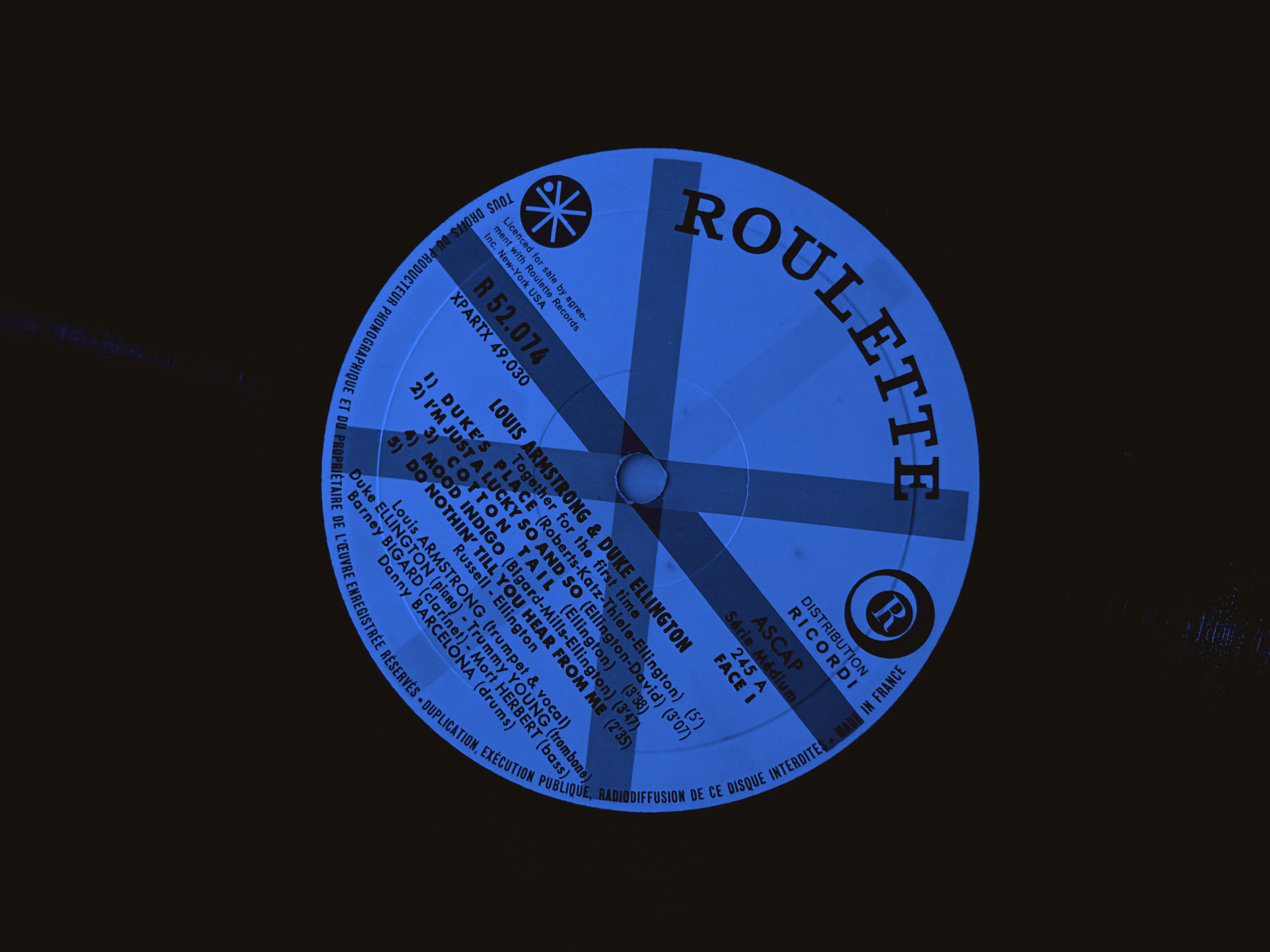
Compare both labels with the candidate’s photos: logo, colours, numbers, track listing and small print. A familiar design is a starting point. The editions of Déjà Vu show why: later 1970s US copies keep the catalogue number but carry Atlantic’s Rockefeller Plaza address on the label.
The photo above shows four useful clues on a Louis Armstrong and Duke Ellington record:
- Roulette: the label name.
- R 52.074: the catalogue number on the blue band.
- XPARTX 49.030: the printed matrix number below it.
- Made in France: the manufacturing statement near the lower-right edge.
Keep those identifiers separate. Rights-society initials are another detail, not a manufacturing location. This label says ASCAP and Made in France. Both can be true.
Look closer when it helps
If two candidates share the cover and catalogue number, checking those again will not help. Find the documented detail that separates them.
It may be in the runout, the band between the last music groove and the label. Hold the record by its edges under side lighting and tilt it slowly. Copy the marks on both sides, keeping doubtful characters doubtful.
A number printed on the label is not the same observation as one etched into the disc. Compare like with like. The matrix numbers guide explains what else you may find there.
Compare the actual edition
On Discogs, a master release groups editions of an album. Open the individual release and check your copy against it.
- Match the format and disc count.
- Compare the complete catalogue number and sleeve text.
- Check both labels against the photos.
- Compare runouts when needed, allowing for documented variants.
- Look for a detail that contradicts the match.
A missing photo leaves a question. It does not count as agreement. Neither does the sleeve’s copyright date establish when this copy was pressed.
Know when to leave it open
If two candidates still fit, save both and note the missing evidence. The earliest edition, the most expensive one and the first search result have no special claim on the record in your hands.
You can use Record by Record to work through your collection. A supported match is useful. So is an honest note that you have not settled it yet. You can still play the album.
Questions
My runout differs from the Discogs listing. Is it a different pressing?
Not necessarily. Discogs guidelines say one edition, especially on a major label, may carry many different matrix numbers across individual copies. Those count as manufacturing variations, not separate releases, so one listing can cover several runouts. For smaller releases, a matrix difference can mark a separate edition. If everything else matches, note your runout rather than assuming a new pressing, and ask in the Discogs forum if you are unsure.
What are the LC, price and D.L. codes on some European labels?
They are extra identifiers. A Label Code is four or five digits after LC, allocated to labels by GVL since May 1976. It identifies the label, not the edition, so don’t confuse it with the catalogue number. A price code was assigned to set the record’s price and comes in many forms, from BA 100 to a circled letter. D.L. stands for Depósito Legal, a legal deposit number. US labels largely lack all three; many European pressings carry them.
What if there is a sticker on the sleeve or label?
Treat it as separate evidence. A sticker added after manufacture, by a distributor for instance, may tell you who handled that copy, not how the record was made. Discogs asks contributors to say when information comes from a sticker and to name the company where possible. When you compare, check whether the candidate listing records the same sticker before counting it for or against a match.
The scanned barcode doesn’t match the printed digits. Which one is right?
Both can be. Discogs lets contributors enter the printed digits and the scanned result as separate barcodes when they differ, and asks them not to delete one in favour of the other. The spaces and dashes in the printed version are there to help people read it; a scanner does not need them. If the formatted version finds nothing, search with the digits alone, and keep both readings in your notes.
Sources
- support.discogs.com/hc/en-us/articles/360005054893-Database-Guidelines-5-Barcodes-Identifiers
- support.discogs.com/hc/en-us/articles/360008602254-How-To-Find-Information-On-A-Vinyl-Record
- support.discogs.com/hc/en-us/articles/11311682608909-How-To-Add-A-Unique-Version-To-A-Master-Release
- support.discogs.com/hc/en-us/articles/360005055493-Database-Guidelines-16-Master-Release
- support.discogs.com/hc/en-us/articles/360004016474-Overview-Of-Submission-Guidelines-For-Releases