Collecting guides
How to Move a Record and CD Collection… Without Damage
Published
Pack records and CDs upright in small boxes, keep them out of a parked car, number the boxes in shelf order, and let a cold delivery warm up before you open it.
In short
- A foot of LPs weighs about 16 to 20 kg, so records belong in small, strong boxes.
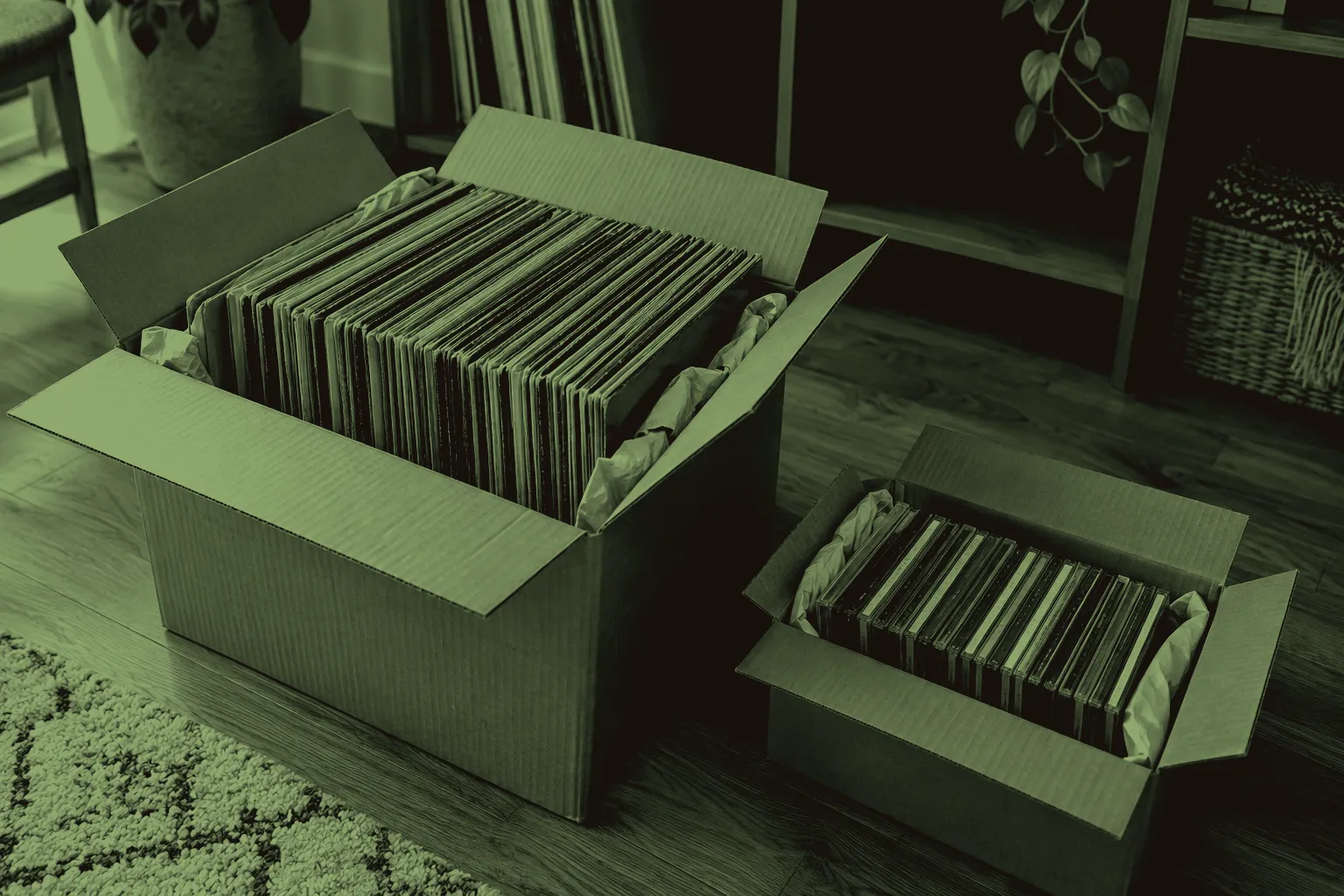
- Pack records and CDs upright, one size per box, snug enough that nothing shifts.
- A warped record doesn't recover, so the boxes never wait in a car parked in sun.
- Number the boxes in shelf order, and unpacking them in sequence rebuilds the shelf.
- After a cold journey, leave the boxes closed for a few hours so nothing gathers condensation.
The shelves are bare, the collection is on the floor in boxes, and it is starting to look heavier than the sofa. Moving it has three jobs: everything arrives, nothing warps, and the shelf goes back in the order it left. This guide takes them in turn, from the first box packed to the last one opened, using what archives and conservators say about carrying recordings.
Before the first box
If you don’t have a list of what you own, a move is the time to make one, as US insurance regulators point out. Records, CDs and collections all appear on the insurance industry’s home-inventory checklist, and a copy of the list belongs somewhere outside the home. One that lives only in a box is no help if the box goes missing.
While you’re at it, check what your home cover and the removers’ cover include for belongings in transit, and for anything travelling in your own car. Policies differ too much for a general figure to mean anything, so read yours.
Two small jobs and one decision remain before packing. Old shrinkwrap should come off completely: it can go on shrinking and warp the record inside, a warning the conservation sources all give. And if you’re swapping tired outer sleeves for new ones, look at what the old ones carry first. Anything found on an original housing is worth recording, in a note or a photograph, before it goes; sound archivists do exactly that before they rehouse a recording. A hype sticker on the shrink counts too.
The decision is which boxes travel with you rather than in the van. The section on heat explains why that choice matters more than it seems.
Boxes and weight
Records are heavy in a way that is easy to miss one sleeve at a time. LPs average 35 to 45 pounds per foot of shelf, by the Library of Congress’s count. Measured per metre, containers included, 12-inch vinyl comes to about 54 kg, 7-inch singles to 21 kg and CDs in jewel cases to 7 kg, in the figures of the International Association of Sound and Audiovisual Archives (IASA).
Now set that against a lift. For a load held close to the body, between elbow and knuckle height, the UK Health and Safety Executive’s guideline is 25 kg for men and 16 kg for women, and less at arm’s length or near the floor. These are guidelines, the HSE is careful to add, not safe limits.
The arithmetic is short, and approximate. A foot of LPs, about 30 cm, comes to roughly 16 to 20 kg on the Library’s figures, and about 16 kg on IASA’s. So a box holding about a foot of LPs already reaches the guideline for women, and comes within 10 kg of the one for men, before anyone carries it down a flight of stairs.
That is why records go in small, strong boxes, the book boxes removal firms keep for heavy things, and never in a large carton. A standard box full of books is too heavy to carry any distance, removers warn, and the bottom may give way.
CDs are the opposite case. At 7 kg a metre, a box of them is light. Their risk is the case and the booklet, not your back.
Packing so nothing leans or slides
Discs travel the way archives keep them: upright, on edge, never flat in piles. The rule covers every recording, CDs included, and in a box each one stands on its spine or edge. Pack one size per box as well: discs of different diameters filed together can warp, and where a box has to mix them, pad the gaps.
Then fill the box, because anything loose can shift, then warp, crack or break. The aim is snug, not crushed: packing that supports without compressing. Museum packers have a simple test for it. Close the box, shake it gently, and if anything shifts, repack it. Tight in a box is not the same as tight on a shelf, either. In transit, discs should be packed so they can’t move against each other; at rest, the same discs shouldn’t be packed tightly at all.
The sleeves deserve the same care as the records. Vinyl is less sensitive to shock than shellac, but it warrants the same protection anyway, for the sake of the covers. The genuinely fragile discs are older. Shellac 78s are among the most shock-sensitive carriers there are, and belong in a box inside a box. Polystyrene 45s are more brittle than vinyl, and likelier to crack.
You may come across the opposite advice, to stack records flat. NEDCC, a conservation lab, gives it, but for a different job: for a few discs posted to the lab by courier it asks for 5 to 10 of the same size, stacked flat between rigid boards, wrapped and cushioned. That is a method for a small parcel, not for a houseful of records.
CDs are simpler. They travel the way they’re stored: upright, like books, in their cases, spines up where you can read them, booklets inside. Flexing a disc can harm it, even while prising it out of a tight case, so press the centre hub and lift the disc by its edge. Cases crack, but a standard jewel case is easy to replace. The booklet isn’t.
Heat and the journey
Heat is the damage you can’t undo: a warp doesn’t come back out. Vinyl that gets too hot softens and flows, deforming the grooves, and even sunlight can cause irreversible deformation. There is a quieter version, too. Each swing of temperature leaves a small permanent deformation in a disc, and the deformations add up.
How hot is too hot? Only roughly known. The international archive standard sets a ceiling of 35 °C for all audio and video carriers: below it, no immediate irreversible harm, and it should not be exceeded. Above 60 °C, plastics and optical discs distort quickly and irreversibly, and surfaces in the sun can reach 75 °C, by the Canadian Conservation Institute’s figures. Retail pages quote warping temperatures without a source, and we found no conservation or pressing-plant source that gives a warp temperature for record vinyl. So don’t plan around a number. Plan around the car.
A parked car heats up fast. A dark sedan parked in the sun warmed on average about 22 °C (40 °F) above the outside air within an hour, on days between 72 and 96 °F, in a 2005 study published in Pediatrics. Most of that rise, 80%, came in the first 30 minutes. Even on the coolest day of the study, the inside reached 117 °F, about 47 °C, and leaving the windows slightly open made no difference.
The plan follows from that. The boxes never wait in a car parked in sun, not while you fetch a coffee and not while you carry the first load upstairs. If you drive them yourself, they ride in the cabin with you rather than shut in a load space. Move in mild weather if you can choose, or early in the day if you can’t: in most places, humidity is lowest at night and in the early morning. On the pavement, keep the boxes in the shade.
CDs are not immune. Heat build-up can warp any disc, and a recordable CD-R left on a car dashboard in summer can become unusable within days.
Keeping the order
Pack in shelf order, one stretch of shelf per box, and the move can put the collection back exactly as it was. Number every box as part of a set, “3 of 12”, the way museums label their shipments. On the top and on at least one side, where you’ll still see it when boxes are stacked, write the range and the room it goes to: “LPs, Beatles to Bowie, living room”. Removers give the same advice: room and contents, on the top and the side. A contents slip inside the lid covers the rest.
The numbered boxes are the order. Unpack them in sequence and the shelf rebuilds itself, one stretch at a time. If the new home means new shelving, the rules for giving each size its own shelf and writing your filing rules down still apply, and the first evening in a new room is a good time to do it properly.
Unpacking
A winter move adds one step. Boxes that come out of a cold van into a warm house can gather condensation, and archivists list exactly this, cold followed by warmer, more humid air, among the typical threats in transport. A temperature drop of more than 10 °C is enough to bring the air to 100% relative humidity. So leave the boxes closed and let them warm up in their packing first: inside, each disc acclimatises gradually.
How long to wait is where the sources part ways: at least two hours and ideally a day in one sound archivists’ guide, when the temperature difference is large, and 24 to 48 hours before museums open a shipment. The strictest archive standard allows no more than 3 °C of change in 24 hours, which no home can manage. For a house move, a few hours is the minimum, and overnight is better when the van was cold and the house is warm.
The records themselves are the least of the worry. Vinyl resists mould and is unaffected by high humidity; the paper around it is what suffers. Conservators draw the practical line for damp at 75% relative humidity, and at 90 to 100% visible mould can appear in about two days. Sleeves and booklets want a room you live in, not a week in a damp garage while the kitchen gets sorted.
Check the shelving before it takes the weight. Records concentrate their weight along the centreline of a shelf, enough to make some shelving collapse, and dividers every 4 to 6 inches keep them standing without leaning. Then unpack one box at a time, straight onto the shelf, in number order. Floor piles are where records end up flat and the order gets lost.
Anything that spent time somewhere warm deserves a look before it goes back on the platter. The eye-level warp check from the used-record guide takes a few seconds a record.
The list you made before the move is now the unpacking checklist: when the last box is empty, every copy on it should be on a shelf. Keep the copies, editions and their condition together in Record by Record, and the next move starts with the list already made.
Questions
Should the records go in the removal van or in my own car?
Either can work; the risk is time spent standing still. A van may be loaded hours before it leaves, or parked overnight, so ask the removers about the schedule and ask for the record boxes to go on last and come off first. If you carry them yourself, you decide where they wait. In that case, look at what your own policy says about belongings kept in a vehicle before the day, not after.
How do I move the turntable?
Follow the manual for your own model, because designs differ. One maker's manual, for example, asks you to take off and pack separately the lid, the counterweight, the anti-skating weight and the belt, to fit the cartridge's protective cap and the tonearm's transport lock, and to keep the original packaging for moving it. If the manual is long gone, the maker is the place to ask, before the deck goes in a box.
Can the collection go into a storage unit between homes?
It can, if the unit is climate-controlled. Archives disagree on the ideal temperature, but they agree on steady conditions away from heat and sun, and the US National Archives rules out an attic or a garage. An unheated unit puts the boxes through every swing between day and night, week after week, and each of those temperature cycles leaves a small, lasting deformation that accumulates. A spare room in a friend's home can be the better choice.
Should I take the records out of their jackets for the move?
Some moving and retail guides suggest it, to prevent ring wear (the circular scuff a disc can print on its sleeve) and split seams. We found no archive or conservation source that asks for it, and the sound archives' own handling standard asks for the covers to get the same protection as the discs. If you do it, keep each disc in its inner sleeve, in the same box as its jacket and in the same order, so nothing ends up in the wrong cover.
A record came out of the box warped. What now?
First find out whether it plays. A gentle dish often tracks fine, while an edge that lifts the stylus is a different matter; [the grading guide](/en/blog/record-grading/) covers where warps sit on the condition scale. Don't try to flatten it at home: we found no conservation source that supports a home method, and heat and pressure are what warp records in the first place. If removers carried it, photograph it before anything else.
Sources
- loc.gov/preservation/care/record.html
- nedcc.org/assets/media/documents/Pres101/6_media_loc_c-cylinder_disc.pdf
- nedcc.org/preservation101/session-6/6storage-and-handling-of-media-collections
- nedcc.org/audio-preservation/packing-and-shipping-audio-media
- iasa-web.org/book/export/html/3812
- clir.org/wp-content/uploads/sites/6/pub164.pdf
- clir.org/pubs/reports/child/sound/
- tsapps.nist.gov/publication/get_pdf.cfm?pub_id=151571
- nps.gov/subjects/museums/upload/MHI_Ch6_HandlingPackingShipping.pdf
- archives.gov/preservation/formats/audio-storage.html
- canada.ca/en/conservation-institute/services/preventive-conservation/guidelines-collections/caring-audio-video-data-recording-media.html
- canada.ca/en/conservation-institute/services/care-objects/electronic-media/video-audio-recordings-8mm-films-faq.html
- canada.ca/en/conservation-institute/services/agents-deterioration/temperature.html
- canada.ca/en/conservation-institute/services/agents-deterioration/humidity.html
- canada.ca/en/conservation-institute/services/preventive-conservation/guidelines-collections/paper-objects.html
- hse.gov.uk/pubns/indg143.pdf
- bar.co.uk/top-ten-packing-tips/
- kidsandcars.org/document_center/download/hot-cars/2005-07-01-heat-stress-enclosed-veh-study.pdf
- content.naic.org/article/consumer-insight-moving-places-changing-spaces
- iii.org/article/brochure-home-inventory
- project-audio.com/wp-content/uploads/2024/04/T2-Manual.pdf