Collecting guides
Record Sizes and Speeds… What Plays at 33, 45 or 78
Published
What 7, 10 and 12-inch records usually are, which speed goes with which size, the exceptions, and how to find the speed when nothing is printed.
In short
- Size suggests the speed: a 7-inch usually turns at 45, a 12-inch LP at 33⅓.
- A 12-inch single or audiophile reissue may run at 45, so check before you play it.
- 78s are brittle shellac with wide grooves, and they need a larger stylus.
- The big hole on a 7-inch is a leftover of RCA's format war with Columbia; an adapter solves it.
- At the wrong speed, pitch and tempo shift together. If nothing is printed, try both.
Buy a box of records at a house clearance and you may find three sizes in it. Some look like albums, some like singles, one or two are somewhere in between and heavier than they look. One of the small ones has a hole in the middle wide enough to fit a thumb through.
Each size and each speed has a history, and once you know it, the size alone is a good first guess at the speed.
Three sizes
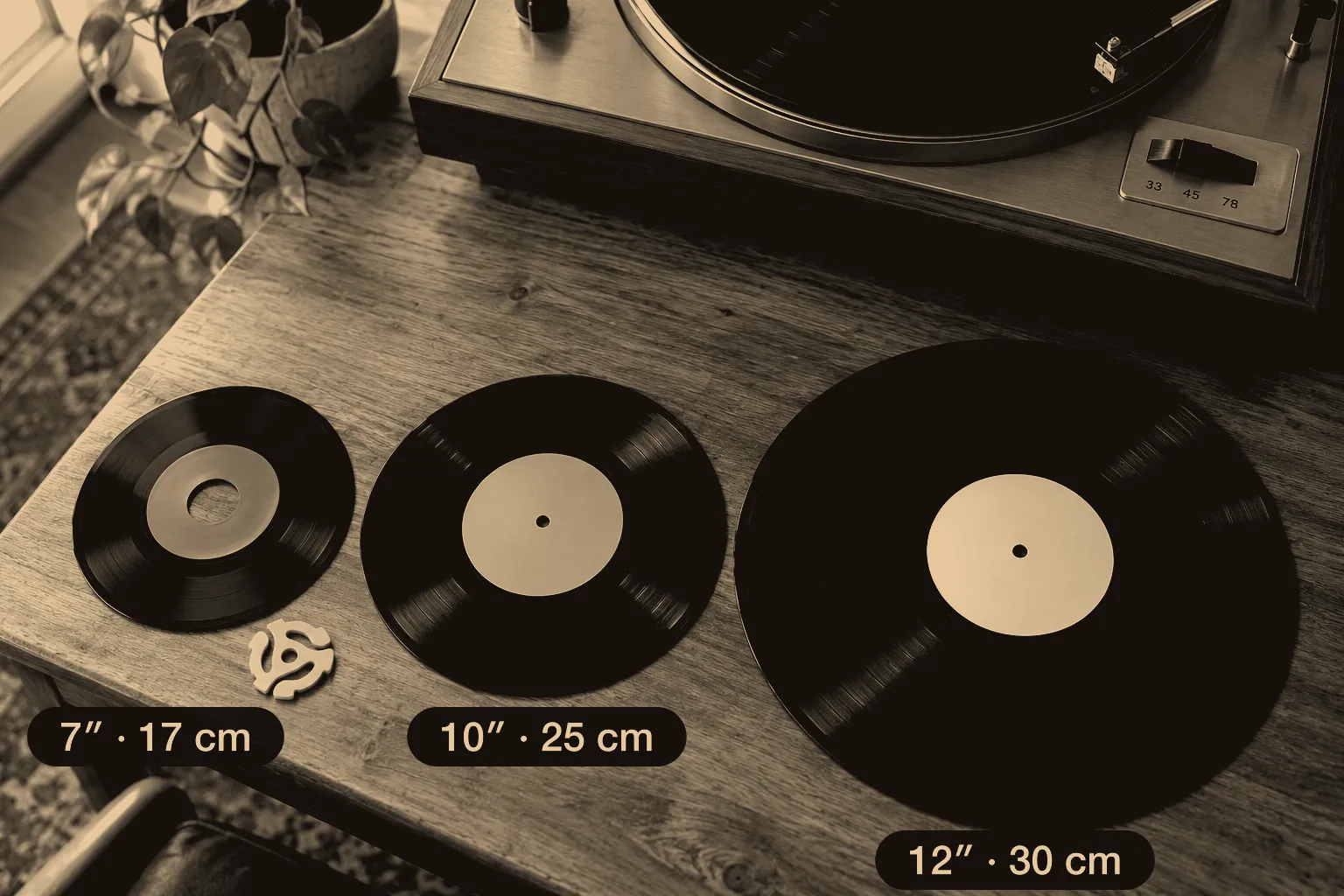
The 7-inch is the single. RCA Victor put out the first 45 rpm single in early 1949, pitched as a smaller, more durable and better-sounding replacement for the shellac 78. The speed was chosen so a side could run about five and a half minutes. Collectors still call these records 45s, after that speed.
The 12-inch is usually the LP, short for long-playing. Columbia unveiled it on 21 June 1948 at the Waldorf-Astoria, at 33⅓ rpm, with a finer “microgroove” that let a 12-inch side run about 25 minutes. The same size also carries the 12-inch single, sometimes sold as a maxi-single: a format built for disco DJs in the 1970s, whose extra space left room for extended dance mixes.
The 10-inch is the in-between size, and the least predictable. Columbia launched the LP in 10-inch as well as 12-inch, but by the mid-1950s the 10-inch LP had lost out and was discontinued. Before that, 10 inches was the common size for shellac 78s. A 10-inch record in a box of old stock could turn at 33⅓, 45 or 78, so it’s the one to read before you play it.
The speed usually follows the size
For most records, size is a fair first guess.
| Record | Usually | Watch for |
|---|---|---|
| 7-inch | 45 rpm single | EPs at 33⅓ |
| 10-inch | 33⅓, 45 or 78 | Read the label |
| 12-inch | 33⅓ rpm LP | Singles and reissues at 45 |
| Heavy, rigid, 10 or 12-inch | 78 rpm shellac | Needs a 78 stylus |
The table is a starting point, not a rule. The exceptions below are common enough that you’ll run into them soon.
The exceptions
12-inch records at 45
A 12-inch single can run at either speed. Many labels in the 1970s cut them at 33⅓, though 45 gives better treble. The wider spacing between grooves also allows a louder cut with deeper bass, which suits dance music. The same thinking has reached albums: some audiophile reissues are cut at 45 and pressed on two discs, with four sides where the original had two. The faster the record turns, the longer the stretch of groove holding each second of music.
7-inch records at 33
RCA answered the LP in 1952 with “Extended Play” 45s, several songs on a single 7-inch. The EP has come in both speeds since, so a small record with several tracks a side may well be at 33⅓.
78s
For about half a century records were usually made of shellac and turned at 78 rpm. In the US, 78s were still being made alongside the new formats until the summer of 1958. You can tell one before you read a word: shellac is rigid and brittle, and it doesn’t flex the way vinyl does. Handle it like a dinner plate. The grooves are much coarser too, roughly 80 to 100 to the inch, compared with up to 260 on vinyl.
That coarse groove matters for the stylus, the tip that rides in the groove. An LP stylus has a tip radius of at most 25 micrometres; a dedicated 78 stylus has a tip more than twice that size. 78s need the larger tip to play properly, which is why the typical home record player of the stereo era had a combination cartridge with one stylus for each groove size and a way to flip between them.
Why a 7-inch has a big hole
In North America, the standard 45 has a 1½-inch (38 mm) centre hole, made to fit RCA’s own spindle. An LP turntable has a ¼-inch (6 mm) spindle. The mismatch is a leftover from the format war between RCA and Columbia, and it outlived the war by decades. RCA’s players stacked a pile of 45s on a tall spindle and dropped them one at a time, the way changers had handled 78s.
The fix is the 45 adapter: a small plastic or metal insert that snaps into the hole, known as a spider, often in yellow or red. There are also larger adapters that sit over a changer’s spindle to hold a stack.
In the UK and Australia, 45s usually came with a small hole and a knock-out centre that you could remove for a player with a large centre spindle. Some British labels moulded the centre with notches holding the centre in place. So a small-hole 7-inch isn’t necessarily a later pressing; it may simply be from a different country. If you’re working out where and when yours was pressed, the guide to identifying a vinyl pressing takes it from there.
Finding the speed on the record
Start with the label, then both sides of the sleeve, including any sticker on the front. Look for “33⅓”, “33”, “45” or “78”, with or without “RPM”.
Then check the runout, the smooth band between the last track and the label, where the hand-etched and stamped markings sit. Our guide to reading matrix numbers in the runout explains what the rest of those markings mean.
If nothing is printed anywhere, play it. Start at 33⅓, listen to the first few seconds, then switch to 45. Voices are the easiest to judge: at the wrong speed they sound too deep or too high.
What the wrong speed sounds like
Pitch and tempo move together, by the same ratio as the speed. Play a 45 at 33⅓ and it runs about a quarter too slow, and lower. Play an LP at 45 and it runs about a third too fast, and higher: the chipmunk effect.
A 78 needs two things to sound right: the 78 setting and the larger stylus. Getting only the speed right is not enough.
A wrong speed can also go unnoticed on a record you don’t know well. If a song you’ve only ever heard on this copy sounds oddly sluggish, check the setting before you write the record off. When you’re buying, the speed is worth confirming with the seller alongside the condition, and the guide to buying used vinyl covers what else to ask.
Keeping track
A shelf with all three sizes on it tends to get sorted by size, because that’s what fits. The speed is easier to forget, especially on the 10-inch and the 12-inch singles. Record by Record stores each copy’s format and size, and the speed when the release lists one, so the next time you pull out that heavy 10-inch, you know what to set before the needle drops.
Questions
What are 16 rpm records?
A fourth speed, half of 33⅓, used almost entirely for spoken word. Earlier talking books for blind and partially sighted listeners ran at 16⅔, and in 1959 Seeburg built a background-music system around 9-inch discs at that speed, with a 2-inch centre hole. Some home players offered it as a fourth setting. If your turntable doesn't, a 16 rpm record will play at double speed at 33⅓, so it needs a player that has the speed.
Can one record play at more than one speed?
Yes, though it is rare. A side can be cut in separate bands, and each band can have its own speed. The best-known case is Moby Grape's 1968 album Wow: after the fourth song on side one, a spoken announcement tells you to switch from 33 to 78 for the next band, and the last song needs another change. So if a track suddenly sounds wrong halfway through a side, check the sleeve notes before the turntable.
Can my turntable play 78s?
Look at the speed selector first. If 78 isn't there, the platter can't reach it and the record will play too slowly to be useful. If it is, you still need a stylus sized for coarse grooves. Record players built when 78s were still sold often carried a flip-over cartridge with a tip for each groove size, so on an older machine, turn the cartridge over before blaming the record.
What is a flexi disc?
A record pressed into a thin, bendable sheet of vinyl, given away with magazines and as a promotional item, most commonly from the 1960s to the 1980s. It plays on an ordinary turntable, but it is so light that the stylus can stop it turning. Most have a marked spot where you place a coin to add grip. If your platter isn't flat, lay the flexi on top of a full-size LP instead.
Why do some jukebox 7-inch records play at 33?
Columbia pressed 7-inch singles at 33⅓ in 1949 and soon dropped them as RCA's 45 caught on. In 1962 Seeburg revived the idea for jukeboxes: shortened, stereo versions of albums on 7-inch discs at 33⅓, after Mercury and Cadence had failed to sell the same format to the public as miniature LPs. If a small record came out of a jukebox, try 33 first.
Sources
- en.wikipedia.org/wiki/Phonograph_record
- en.wikipedia.org/wiki/LP_record
- en.wikipedia.org/wiki/Single_(music)
- en.wikipedia.org/wiki/Twelve-inch_single
- en.wikipedia.org/wiki/Extended_play
- en.wikipedia.org/wiki/45_rpm_adapter
- en.wikipedia.org/wiki/Flexi_disc
- en.wikipedia.org/wiki/Unusual_types_of_analogue_disc_record
- en.wikipedia.org/wiki/Audio_time_stretching_and_pitch_scaling
- psap.library.illinois.edu/collection-id-guide/phonodisc
- ortofon.com/products/2m-78
- breedmedia.co.uk/blog/guide-to-vinyl-sizes-and-speeds-1/
- audiophilia.com/reviews/2025/1/26/yes-fragile-analogue-productions-atlantic-75-vinyl-review-2-lp-45rpm-2025