Perfect Albums series
The Beatles
Abbey RoadThe story and the copies worth owning
Published
In short
- Abbey Road is the last album the Beatles recorded, though Let It Be was released after it.
- Most of side two of Abbey Road is a 16-minute medley of eight songs, built from unfinished pieces.
- JPC, Acoustic Sounds and Music Direct sell new Abbey Road LPs only in Giles Martin's 2019 mix.
- For the 1969 mix on vinyl, the route is used: a later Apple pressing or the 2012 LP.
- On CD, the 2009 remaster carries the 1969 mix and the 2019 anniversary CD the new one.
Abbey Road was made by a band that could no longer agree on who should look after its money. At a business meeting at Olympic Studios, the Beatles voted three to one to appoint Allen Klein, with Paul McCartney against: the first time they had not been unanimous. “It was the crack in the Liberty Bell,” McCartney said. “It never came back together after that one.” Their producer, George Martin, had assumed after Let It Be that he would never work with them again, and when McCartney rang to ask for one more record, Martin set a condition: “Only if you let me produce it the way we used to.” Six days before the album came out, John Lennon told McCartney, Ringo Starr and Klein that he “wanted a divorce”. Whether they knew in the studio that this was the end is still argued over. Beatles historian Mark Lewisohn, who holds a tape of three of them planning the next album, hears a band “in an almost entirely positive frame of mind”. And the record they left behind runs seventeen tracks without a weak one, from “Come Together” to the stray coda of “Her Majesty”.
What kind of record it is
Two records, really, one on each side. Side one is six separate songs. Side two opens with two more, then runs into a 16-minute medley of eight tracks that was known during the sessions as “The Long One”. The shape is usually told as a compromise between Lennon, who wanted separate songs, and McCartney and Martin, who wanted a suite in the manner of Sgt. Pepper. Each side got its way.
It was also the first Beatles album recorded entirely on eight-track tape and through EMI’s transistor desk, the TG12345. Engineer Geoff Emerick remembered the desk having “a limiter and compressor on every channel”, as he told MusicRadar, and the extra tracks let him record Starr’s drums in stereo for the first time. George Harrison had bought a Moog synthesiser, and it turns up on four songs, from “Maxwell’s Silver Hammer” to “Because”. “There wasn’t an instruction manual,” he said in Anthology.
Critics in 1969 were divided. Half a century later, Rolling Stone placed it fifth on its 2020 list of the 500 greatest albums.
Six months in three studios
The first session was at Trident Studios in Soho on 22 February 1969. It produced the backing track of “I Want You (She’s So Heavy)”, with Billy Preston on Hammond organ. From there the work moved between Trident, Olympic Sound Studios in Barnes and EMI Studios on Abbey Road itself, which took the street’s name only in 1976, after the album. For July and August the band block-booked EMI’s Studio Two, from 2.30pm to 10pm.
The booking began on 1 July, the day Lennon crashed his car in Scotland. The others carried on without him until 9 July. When he came back, Yoko Ono, more badly hurt than he was and pregnant, came too: Lennon had a double bed sent over from Harrods and set up in the studio, and she lay in it with a microphone above her.
Even so, Harrison remembered the summer in Anthology as a better time: “During the album things got a bit more positive … we got to play the whole medley … We did actually perform more like musicians again.” On 20 August 1969 they sequenced the album and mixed “I Want You”. It was the last day all four Beatles were in a studio together. Abbey Road is the last album they recorded; Let It Be, begun earlier, was finished and released after it.
The songs
- “Come Together” is Lennon’s, and it grew out of a slogan: “Come Together – Join the Party!”, written for Timothy Leary’s planned run for Governor of California. Lennon reworked it in July 1969, and its debt to Chuck Berry’s “You Can’t Catch Me” brought a lawsuit from Big Seven Music, the publishing company of Morris Levy; the 1973 settlement had Lennon record Big Seven songs for his next album. Starr played with tea towels over his tom-toms, and McCartney played a Fender Rhodes electric piano. Lennon counted it among his favourite Beatles tracks, in a line Rolling Stone quoted in 2011: “It’s funky, it’s bluesy, and I’m singing it pretty well.”
- “Something” is Harrison’s, begun in September 1968 during the sessions for the White Album. The basic track the album uses was cut on 2 May 1969, with Preston on organ again. Martin’s strings were added on 15 August, while Harrison re-recorded his solo live. Frank Sinatra called it “the greatest love song of the past 50 years”.
- “Maxwell’s Silver Hammer” is McCartney’s, and nobody else enjoyed it. It took several sessions from 9 July, Lennon’s first day back after the crash, and McCartney added a Moog solo on 6 August. “The worst session ever was ‘Maxwell’s Silver Hammer.’ It was the worst track we ever had to record,” Starr told Rolling Stone in 2008. Harrison, to Crawdaddy in February 1977: “‘Maxwell’s Silver Hammer’ was so fruity.”
- “Oh! Darling” is McCartney’s too, and he took it in small doses: one attempt a day. “I came into the studios early every day for a week to sing it by myself because at first my voice was too clear,” he said in Anthology. “I wanted it to sound as though I’d been performing it on stage all week.”
- “Octopus’s Garden” is Starr’s second and last solo composition on a Beatles album. The idea came in Sardinia in 1968, on Peter Sellers’s yacht, on a family trip taken after Starr had walked out of the band for two weeks during the White Album sessions. The captain told him how octopuses gather stones and shiny objects. Harrison helped with the chords and, at Starr’s request, made the bubbling sounds with a straw in a glass of milk.
- “I Want You (She’s So Heavy)” is Lennon’s song about Ono, the first recorded for the album and among the last finished. He added Moog white noise on 8 August, the day of the cover shoot, and then, instead of a fade, had the tape cut dead at 7:44. “I thought the song was going to have a fade out, but suddenly John told me, ‘Cut the tape,’” Emerick remembered. Side one ends there.
- “Here Comes the Sun” is Harrison’s, written in April 1969 in the garden of Eric Clapton’s house in Ewhurst, Surrey, on a day he should have been at Apple. “So one day I decided I was going to sag off Apple and I went over to Eric Clapton’s house,” he said in Anthology. “The relief of not having to go and see all those dopey accountants was wonderful.” The basic track was recorded without Lennon, and a Moog finished it on 19 August.
- “Because” is Lennon’s. In All We Are Saying, his 1980 interviews with David Sheff, he says he heard Ono playing Beethoven’s “Moonlight” Sonata and asked her to play the chords backwards, though the writer Dominic Pedler finds the chords are not literally the sonata reversed. Lennon, McCartney and Harrison sang a three-part harmony three times over, nine voices in all, and Martin played electric harpsichord. The main session, on 1 August, was the last backing track taped for the album. “They knew they were doing something special,” Emerick said.
- “You Never Give Me Your Money” opens the medley. McCartney’s basic track was cut at Olympic on 6 May. In Many Years From Now, his 1997 book with Barry Miles, he says it was written with Klein in mind: “it’s basically a song about no faith in the person”. The critic Ian MacDonald doubted that reading, since the backing track came before the worst of the rows between the two men.
- “Sun King” is Lennon’s, worked up under the title “Here Comes the Sun King”. Harrison remembered how they started it: “Let’s be Fleetwood Mac doing ‘Albatross’, just to get going,” he told Musician in 1987. The Spanish is mock Spanish. “We just strung any Spanish words that sounded vaguely like something,” Lennon said in 1969.
- “Mean Mr. Mustard” is one of the songs Lennon wrote in Rishikesh in 1968. It came from a newspaper story about a miser, and in the demo Mr. Mustard’s sister was called Shirley. Lennon changed her name to Pam, which ties the song to the next one.
- “Polythene Pam”, also Lennon’s from Rishikesh, draws on a Cavern fan known as “Polythene” Pat Dawson and on a night in Guernsey in August 1963 with the poet Royston Ellis and his girlfriend. It was recorded with the next song as one piece.
- “She Came In Through the Bathroom Window” is McCartney’s, about the fans known as Apple scruffs who climbed a ladder into his house in St John’s Wood. One of them, Diane Ashley, told the writer Steve Turner in 1994: “I was the one who climbed up and got in.”
- “Golden Slumbers” sets words from “Cradle Song”, in the 1603 play Patient Grissel by Thomas Dekker. McCartney found the sheet music at his father’s home in Liverpool, left there by his stepsister Ruth; he could not read it, so he wrote his own tune. It was recorded on 2 July, while Lennon was in hospital, as one piece with the next song, and a 30-piece orchestra was added on 15 August.
- “Carry That Weight” is sung in unison by all four, and it brings back the tune of “You Never Give Me Your Money”. In Many Years From Now, McCartney remembers Apple after Klein arrived: “It was serious, paranoid heaviness and it was just very uncomfortable.”
- “The End” was the last song all four Beatles recorded together, as MacDonald counts it, and it holds Starr’s only drum solo with the band. Martin talked him into it. “Solos have never interested me,” Starr said in Anthology. “That drum solo is still the only one I’ve done.” Then McCartney, Harrison and Lennon trade two-bar guitar solos, in that order, three times round. “They reminded me of gunslingers,” Emerick said. “Yet there was no animosity, no tension at all.” It closes on one couplet, about love given and love returned.
- “Her Majesty” was never meant to be heard. McCartney recorded it on 2 July, and on 30 July it was cut from the medley. Tape operator John Kurlander had orders not to discard any recording, so he stuck it on the end of the reel after a stretch of blank leader tape. That is why it opens on the last chord of “Mean Mr. Mustard” and stops short. McCartney kept it, but the original sleeve did not list it.
“Something” and “Come Together” came out as a double A-side, in America on 6 October 1969 and in Britain on 31 October: Harrison’s first A-side with the Beatles. It spent a week at number one on the Billboard chart and reached number four in the UK. The album spent 17 weeks at number one in Britain, with a single week’s break when the Rolling Stones’ Let It Bleed took the top spot, and 11 weeks at number one in America.
In their own words
Martin, in Anthology, called it “a very happy record. I guess it was happy because everybody thought it was going to be the last.” He was careful about what they knew: “Nobody knew for sure that it was going to be the last album – but everybody felt it was.” And he was fond of it for a simple reason: “Everybody worked frightfully well, and that’s why I’m very fond of it.”
Lennon kept changing his mind about what he had made, and each version has a date. In 1969, as Anthology reprints it, he described his medley songs this way: “We juggled them about until it made vague sense … They are only finished bits of crap that I wrote in India.” A year later he told Jann Wenner in the interviews published as Lennon Remembers: “I liked the A side. I never liked that sort of pop opera on the other side. I think it’s junk.” Of the whole: “It was a competent album, like Rubber Soul in a way … but it had no life really.” And in 1980, to Sheff: “Abbey Road was really unfinished songs all stuck together.”
Who stuck them together is a question McCartney answers with care in Anthology: “I think it was my idea to put all the spare bits together, but I’m a bit wary of claiming these things.” Martin, in the same book, claimed a share, saying that he and McCartney “put together the long side” and that “John objected very much”.
Starr, also in Anthology, heard that side differently from Lennon: “After the Let It Be nightmare, Abbey Road turned out fine. The second side is brilliant. Out of the ashes of all that madness, that last section is for me one of the finest pieces we put together.”
Harrison took his first A-side lightly. “They blessed me with a couple of B-sides in the past, but this is the first time I’ve had an A-side. Big deal, eh?” he told the BBC’s David Wigg on 8 October 1969.
Lewisohn’s tape of the Apple meeting catches three of them being frank with each other. Lennon tells McCartney that nobody else in the group “dug” “Maxwell’s Silver Hammer”. McCartney: “I recorded it because I liked it.” Then McCartney: “I thought until this album that George’s songs weren’t that good.” Harrison: “That’s a matter of taste. All down the line, people have liked my songs.”
The sleeve
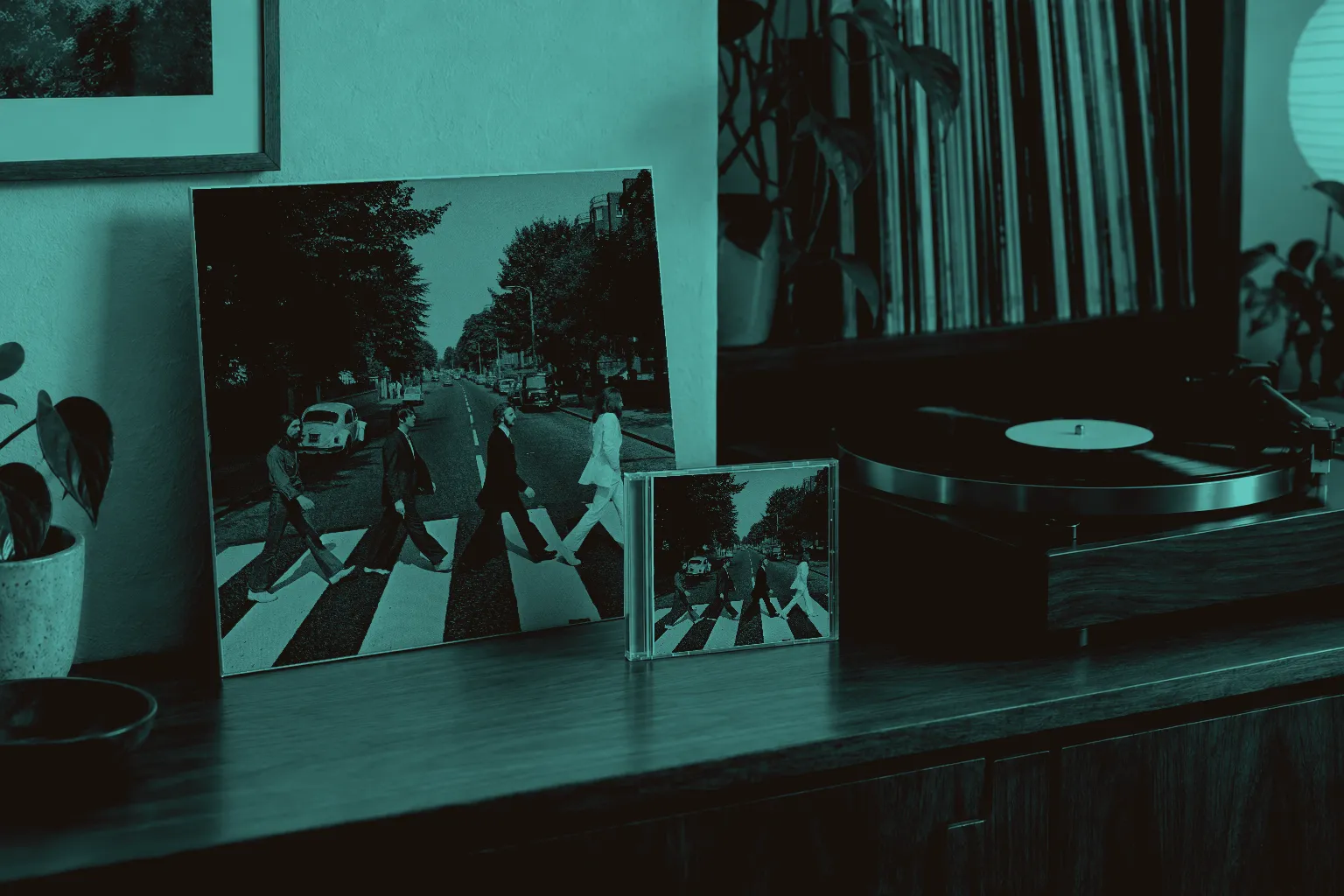
Iain Macmillan took the photograph late on the morning of 8 August 1969, standing on a stepladder in the road while a policeman held up the traffic. He worked from a sketch by McCartney, and it was over in minutes. Most accounts count six frames, though Brian Southall, who wrote the history of the studios, told BBC News in 2009 it was “only seven or eight pics”. McCartney chose the fifth after going over them with a magnifying glass. From left to right in the frame: Harrison in denim, McCartney barefoot and out of step, Starr in black, and Lennon leading in white. The white Volkswagen Beetle parked behind them belonged to a resident of the flats opposite.
The design was by Apple’s creative director, John Kosh, and it is the only original UK Beatles sleeve with neither the band’s name nor the title on the front. “I insisted we didn’t need to write the band’s name on the cover. They were the most famous band in the world after all - EMI said they’d never sell any albums if we didn’t say who the band was, but I got my way, and got away with it,” Kosh told BBC News in 2009.
The photograph did not stay innocent for long. Believers in the “Paul is dead” rumour read it as a funeral procession: McCartney barefoot, a cigarette in his right hand, and the Beetle’s number plate, LMW 281F, as “28 IF”. Starr answered it on 23 October 1969, talking to Alex Bennett of the New York radio station WMCA: “If people are gonna believe it, they’re gonna believe it. I can only say it’s not true.” In December 2010 the zebra crossing itself was listed at Grade II for its “cultural and historical importance”.
On the sleeve itself, two details date a copy quickly. The back of the first UK printing has a misaligned Apple logo, later corrected; on the first US printing the photograph is uncropped, the square metal street lid visible at the bottom of the frame. The pressings below say more.
Which copy to buy
Before choosing a copy, know which mix you want, because two different ones are on sale. The 1969 stereo mix is on the originals, the 1980 Mobile Fidelity LP, the 1987 and 2009 CDs and the 2012 LP. Every 2019 anniversary edition, and the LPs pressed since 2025, carry a new stereo mix by Giles Martin and Sam Okell, made from the original eight-track tapes. A remix rebalances the voices and instruments themselves, so it is a different record, not a cleaner copy of the same one; our guide to originals, reissues, remasters and remixes explains the difference.
On vinyl
Shop prices were checked on 27 September 2026. For used prices, follow the Discogs link on each edition.
-
The 1969 UK original, Apple PCS 7088. Pressed by EMI, with matrix numbers YEX 749 and YEX 750; the runout, the smooth band between the last groove and the label, is stamped “YEX 749-2” and “YEX 750-1” followed by letter codes. The sleeve was printed by Garrod & Lofthouse. On the first sleeves the Apple logo on the back is misaligned and the front photo is cropped tighter, with less sky and less of the street lid at bottom right; on the first labels, side two does not list “Her Majesty”. Copies with the aligned logo and the street lid in view, but still the first label, came next; labels that list “Her Majesty” came later still. The copy Britain bought in September 1969: check the Apple logo on the back and the side two label. Used only: sales history on Discogs.
-
The 1969 US original, Apple SO-383. Manufactured by Capitol, and the side two label reads “MFD. BY APPLE RECORDS, INC.”. On the first US sleeves the photo is uncropped, so the square metal street lid shows at the bottom, and “Her Majesty” is on neither cover nor label. By the Discogs release notes, which users write, Abbey Road was the only Beatles album issued in print-on-board covers, the picture printed straight onto the cardboard, and a later batch of pasted-slick covers used an enlarged photo that loses the lid. Capitol’s plants left their mark in the runout: an “O” for Jacksonville, a star for Los Angeles, a horn-shaped ”◄” mark for Winchester, “IAM” in a triangle for Scranton. Represses from November 1969 add “Her Majesty” to label and jacket. The copy America bought in October 1969: the street lid and the missing “Her Majesty” date it. Used only: sales history on Discogs.
-
The 1980 Mobile Fidelity half-speed, MFSL 1-023. Half-speed mastered (the tape and the cutting lathe both run at half speed) by Stan Ricker at the JVC Cutting Center and pressed by JVC in Japan, with “SR/2” hand-etched in the runout, a yellow “Original Master Recording” banner across the top of the cover and a white label with the Capitol “C”. It was Mobile Fidelity’s first Beatles release; the sleeve reads © 1979. The older audiophile route, in the 1969 mix. Used only: sales history on Discogs. One owner review ranks it second only to the 2019 LP.
-
The 2012 180g LP, PCS 7088. The 2009 digital remaster on vinyl, cut by Sean Magee, whose “i…i” mark is in the runout, and pressed by Optimal Media in Germany. The runout is etched “94638246817 BA92379-01” or “BA98379-01”, and “Her Majesty” is listed nowhere on sleeve, label or sticker. The last LP of the 1969 mix, and now a used buy. Not available new: JPC lists it as currently unavailable; Acoustic Sounds listed a used copy graded Mint Minus at $25.00, limited stock. Used: sales history on Discogs.
-
The 2019 anniversary LP, 0602577915123. Giles Martin’s mix, cut at half speed by Miles Showell at Abbey Road Studios: the runout is etched “MILES. ABBEY ROAD ½ SPEED.ROOM 30”. European copies are 180g from Optimal Media; US copies are numbered B0030719-01. Pressings from 2025 under the same barcode have “BP36617-01” in the runout and no Miles Showell etching — a different lacquer cut, by the Discogs notes — so a new copy may be either one. The one new black LP at the three shops below, in the 2019 mix: check the runout to see which cut you have. New: JPC €34.99, ready to ship within three days if the supplier has it; Acoustic Sounds $29.98 in stock, Music Direct $29.99 in stock. Used: sales history on Discogs. Owners mostly like the new mix; the complaints are surface noise on some copies and, from one listener, a flat half-speed cut.
-
The 2019 anniversary 3LP box, 0602508007446. The 2019 LP plus Abbey Road Sessions, two LPs of outtakes, demos and studio chat, all 180g from Optimal Media and every side cut at half speed by Showell, in a top-opening box with a fold-out booklet. The making of the album on vinyl: the sessions discs are the reason to buy it. New: JPC €119.99, delivery in at least four weeks; Acoustic Sounds $89.98 in stock. Used: sales history on Discogs.
Best value
-
Take the 2019 LP on black vinyl. At €34.99 from JPC or $29.98 from Acoustic Sounds, it is the only new black single LP of Abbey Road that JPC, Acoustic Sounds and Music Direct list, and it is the 2019 mix. JPC also lists a 2025 green pressing of the same mix at €49.99, on a different cut; take black unless you want the colour.
-
For the 1969 mix on vinyl, the route is used: a later UK or US Apple pressing, or the 2012 LP. None is an original, and we found no source saying any of them sounds better than another. The risk is condition, so read how to grade a record before you pay, and our pressing identification guide before you believe a seller’s “first pressing”.
-
On CD, it depends on the mix. For the new one, the 2019 anniversary CD is €18.99 at JPC. For the 1969 mix, look for a used 2009 remaster.
On CD
-
The 2009 remaster, 0946 3 82468 2 4. “This remastered album has been created from the original stereo analogue master tapes,” the notes say, and it came out on 9 September 2009. A card wallet with a booklet, an enhanced disc with a video file, and “Her Majesty” as a separate track 17. European discs were pressed by Cinram; the Japanese TOCP-71013 is the same remaster. The 1969 mix on CD, remastered from the original tapes. Not available new: JPC lists it as currently unavailable. Used: sales history on Discogs.
-
The 2019 anniversary CD, 0602508007439. Giles Martin’s mix on one disc, mastered by Miles Showell, in a four-panel digisleeve with a 20-page booklet; the matrix reads “0800748 AJ76370-01”. The simplest way to hear the new mix. New: JPC €18.99, ready to ship within three days if the supplier has it. Used: sales history on Discogs.
-
The 2019 anniversary 2CD, 0602577915079. The first disc is the 2019 mix; the second follows the album’s running order in outtakes, demos and variants. A gatefold digisleeve in a slipcase, with a 40-page booklet. The making of the album on CD, at a sensible price. New: JPC €31.99, ships within two to three weeks. Used: sales history on Discogs. One owner found the new mix vivid but the second disc a letdown: the band rehearsing, not an alternative album.
-
The 2019 super deluxe, 3CD and Blu-ray, 0602577921124. Three CDs of the 2019 mix and the sessions, and a Blu-ray audio disc with Dolby Atmos, 5.1 surround and high-resolution stereo, in a hardback book in an LP-sized slipcase. The one format with the surround and Atmos mixes. New: JPC €131.99, ships within one to two weeks; Acoustic Sounds $109.98 in stock. Used: sales history on Discogs.
The first CD, CDP 7 46446 2 from 1987, reads “Digitally re-mastered ℗ 1987” and turns up used on Discogs. JPC has a plain CD in stock at €14.99, listed under that 1987 barcode, but the listing does not say which master it ships, so read the small print on the disc when it arrives: “Digital Remaster ℗ 2009” means the 2009 remaster.
What to check on a used copy
Start with the runout. On a UK original, look for YEX 749-2 and YEX 750-1; on a US copy, the plant mark tells you where it was pressed. Our guide to matrix numbers shows how to read them. Then the sleeve and label: the Apple logo on the back, the street lid on the US front, and whether “Her Majesty” is listed. On the 2019 LP, “MILES” in the runout means the half-speed cut, “BP36617” the 2025 one. On a CD, read the catalogue number and the remaster line; our guide to buying used CDs shows where to look.
When your copy arrives, put the edition in Record by Record — catalogue number, mix, year. It is the reference every later “first pressing” gets measured against.
Questions
Why is the album called Abbey Road?
Its working title was Everest, after the cigarettes engineer Geoff Emerick smoked. McCartney proposed Abbey Road instead, the name of the street outside EMI's studio, and in Anthology he gave two reasons in one breath: "it's the studio we're in … and it sounds a bit like a monastery." The studio did not take the street's name for itself until 1976, seven years after the album.
Was Abbey Road ever released in mono?
No. Abbey Road was the first Beatles album never issued in mono anywhere, so a listing that offers a mono original has it wrong. It was never mixed in mono at all. For the same reason it is missing from The Beatles in Mono, the box set that gathers the band's mono albums. Every edition on this page is stereo; the super deluxe adds surround mixes on Blu-ray.
How did critics review Abbey Road in 1969?
With mixed feelings. Nik Cohn, writing in The New York Times on 5 October 1969, heard the medley as their most impressive music since Rubber Soul but found the songs, taken one at a time, "nothing special". John Mendelsohn, in Rolling Stone on 15 November, called it "breathtakingly recorded". Albert Goldman, in Life, was blunter: in his view it "is not one of the Beatles' great albums".
What happened to the white Volkswagen on the cover?
Its number plate, LMW 281F, was stolen again and again. The car itself was sold at auction in 1986 for £2,530 and later went on display in a museum in Germany. The Beatles Bible names the Autostadt in Wolfsburg; Wikipedia says only a German museum, so check before you plan a visit around it.
Did the Beatles plan another album after Abbey Road?
On one tape, they did. Lennon recorded a meeting at Apple for Starr, who was in hospital, and Mark Lewisohn, who holds it, dates it to 8 September 1969. On it Lennon suggests four songs each from himself, McCartney and Harrison for the next record, two from Starr, and a Christmas single. Twelve days later Lennon said he wanted out, though nothing was announced until McCartney said he was leaving in April 1970.
Sources
- en.wikipedia.org/wiki/Abbey_Road
- en.wikipedia.org/wiki/Come_Together
- en.wikipedia.org/wiki/Something_(Beatles_song)
- en.wikipedia.org/wiki/Maxwell's_Silver_Hammer
- en.wikipedia.org/wiki/Oh!_Darling
- en.wikipedia.org/wiki/Octopus's_Garden
- en.wikipedia.org/wiki/I_Want_You_(She's_So_Heavy)
- en.wikipedia.org/wiki/Here_Comes_the_Sun
- en.wikipedia.org/wiki/Because_(Beatles_song)
- en.wikipedia.org/wiki/You_Never_Give_Me_Your_Money
- en.wikipedia.org/wiki/Sun_King_(song)
- en.wikipedia.org/wiki/Mean_Mr._Mustard
- en.wikipedia.org/wiki/Polythene_Pam
- en.wikipedia.org/wiki/She_Came_In_Through_the_Bathroom_Window
- en.wikipedia.org/wiki/Golden_Slumbers
- en.wikipedia.org/wiki/Carry_That_Weight
- en.wikipedia.org/wiki/The_End_(Beatles_song)
- en.wikipedia.org/wiki/Her_Majesty_(song)
- en.wikipedia.org/wiki/Iain_Macmillan
- en.wikipedia.org/wiki/John_Kosh
- en.wikipedia.org/wiki/Paul_is_dead
- en.wikipedia.org/wiki/Abbey_Road_Studios
- en.wikipedia.org/wiki/Trident_Studios
- en.wikipedia.org/wiki/Olympic_Studios
- beatlesbible.com/albums/abbey-road/
- beatlesbible.com/albums/abbey-road/2/
- beatlesbible.com/albums/abbey-road/3/
- beatlesbible.com/albums/abbey-road/4/
- beatlesbible.com/albums/abbey-road/5/
- theguardian.com/music/2019/sep/11/the-beatles-break-up-mark-lewisohn-abbey-road-hornsey-road
- news.bbc.co.uk/1/hi/8188475.stm
- discogs.com/master/24047
- discogs.com/release/2607424
- discogs.com/release/2498807
- discogs.com/release/14262597
- discogs.com/release/20607994
- discogs.com/release/7801798
- discogs.com/release/3972811
- discogs.com/release/6479999
- discogs.com/release/7313452
- discogs.com/release/5642388
- discogs.com/release/11355957
- discogs.com/release/11146250
- discogs.com/release/15284193
- discogs.com/release/22780097
- discogs.com/release/728419
- discogs.com/release/4037087
- discogs.com/release/14186441
- discogs.com/release/14192689
- discogs.com/release/14197634
- discogs.com/release/30834342
- discogs.com/release/35336761
- discogs.com/release/36094351
- discogs.com/release/14183308
- discogs.com/release/4445811
- discogs.com/release/2163504
- discogs.com/release/14722954
- discogs.com/release/2125793
- discogs.com/release/5129753
- discogs.com/release/14198090
- discogs.com/release/14180845
- discogs.com/release/14191596
- jpc.de/jpcng/poprock/detail/-/art/the-beatles-abbey-road-50th-anniversary/hnum/9425903
- jpc.de/jpcng/poprock/detail/-/art/the-beatles-abbey-road-50th-anniversary/hnum/9425898
- jpc.de/jpcng/poprock/detail/-/art/the-beatles-abbey-road-50th-anniversary/hnum/9425902
- jpc.de/jpcng/poprock/detail/-/art/the-beatles-abbey-road-50th-anniversary/hnum/9425982
- jpc.de/jpcng/poprock/detail/-/art/the-beatles-abbey-road-50th-anniversary/hnum/9425989
- jpc.de/jpcng/poprock/detail/-/art/the-beatles-abbey-road-limited-green-vinyl-edition/hnum/12527481
- jpc.de/jpcng/poprock/detail/-/art/Beatles-Abbey-Road-remastered-180g/hnum/4978193
- jpc.de/jpcng/poprock/detail/-/art/Beatles-Abbey-Road/hnum/5484526
- jpc.de/jpcng/poprock/detail/-/art/Beatles-Abbey-Road-Stereo-Remaster-Ltd-Deluxe-Edition/hnum/2847432
- store.acousticsounds.com/d/144758/The_Beatles-Abbey_Road-180_Gram_Vinyl_Record
- store.acousticsounds.com/d/144773/The_Beatles-Abbey_Road-Vinyl_Box_Sets
- store.acousticsounds.com/d/144771/The_Beatles-Abbey_Road-Multi-Format_Box_Sets
- store.acousticsounds.com/d/197817/The_Beatles-Abbey_Road-Preowned_Vinyl_Record
- musicdirect.com/music/vinyl/the-beatles-abbey-road-anniversary-edition-180g-vinyl-lp/