Collecting guides
How to Organise Vinyl and CDs… in One Collection
Published
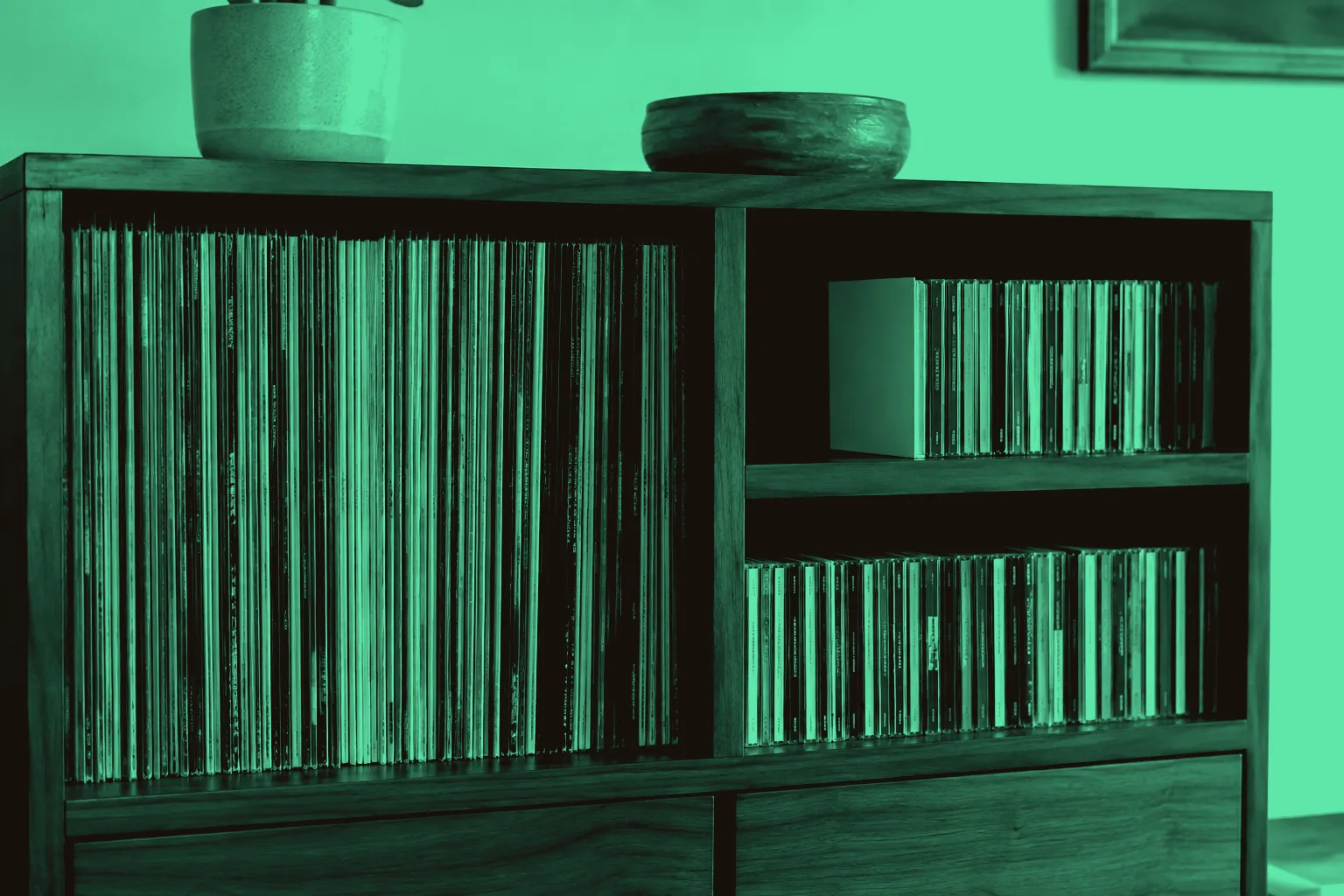
Give each size its own shelf: LPs, 7-inch singles and CDs apart. Then sort by artist. A list of your collection shows an album on LP and CD in one place.
In short
- A shelf holds each copy in one place; a list of your collection shows every copy together.
- Give LPs, singles and CDs separate shelves. Mixed sizes warp records and hide CDs.
- Alphabetical order hides a dozen small decisions, and music databases have already settled most of them.
- Write your filing rules down, so the shelf still makes sense to you next year.
- List each copy separately, with its format, edition, condition and location.
You know you own the album. You can picture the sleeve. The CD turns out to be in a box by the stereo, and the LP is filed under T, because at some point you decided “The” counted.
Organising a mixed collection goes wrong in a predictable way: people ask the shelf to do a job only a list can do. A shelf can hold each copy in exactly one place. A list of your collection, a catalogue, can show every copy of an album together, in every format, wherever each one sits. Let the shelf hold the objects and the catalogue keep track of the music, and most of the difficulty goes away.
Give each size its own shelf
The first decision isn’t artist or genre. It’s diameter.
The Library of Congress’s care guidance says discs must be shelved vertically, ideally between full-height dividers spaced 4 to 6 inches apart, and adds that shelving discs of different sizes together can make them warp. A 7-inch single between two LPs leans. The LPs either side of it lose the support they need along their full face. Over time, that shows up as a record that no longer sits flat on the platter.
CDs have the opposite problem. A standard jewel case is 142 by 125 millimetres, and an LP is a 12-inch disc in a sleeve slightly larger than the disc. A CD is less than half the height of the LP next to it, so a jewel case filed among records drops out of sight. Filed among CDs, an LP doesn’t fit at all.
Those dividers are the other half of the advice, and the half most setups leave out. A long, open shelf of records that is only half full lets the whole row slump sideways, and the Library notes that even dividers shorter than the records may contribute to warping. Shelving divided into compartments does the job for you. On an open shelf, add dividers or firm bookends, and move them as the row grows so the records stay upright without being wedged in. If pulling one sleeve out drags its neighbours with it, the compartment is too full.
So give each size its own run: LPs together, singles together, CDs together. Then use the same order inside every run, so knowing where Joni Mitchell sits among the records tells you where she sits among the CDs. That consistency is what makes separate shelves feel like one collection.
Two practical notes while you’re choosing furniture. LPs average 35 to 45 pounds per foot of shelf, according to the same Library of Congress guidance, and concentrate that weight along the centreline of the shelf, which can overload weaker shelving. And the upright rule applies to everything: the Library says not to lay any recording flat, CDs included.
Alphabetical order is a dozen small decisions
“Alphabetical by artist” sounds like a rule. It is really a list of questions waiting for you. Does Bob Dylan go under B or D? Does The Cure go under T? Where does a band named after its singer go, relative to that singer’s solo records? And what about the band whose name starts with a number?
You don’t have to invent answers. Music databases and libraries settled these long ago, and their conventions are consistent enough to borrow wholesale.
MusicBrainz, the open music encyclopedia, publishes its rules for artist “sort names”, the form a name takes for filing rather than for display. People sort by family name: Eric Clapton becomes “Clapton, Eric”. Groups beginning with an article move it to the end: The Beatles become “Beatles, The”, and A Perfect Circle becomes “Perfect Circle, A”. Groups without an article stay as they are.
The rule for bands named after a person is the one worth knowing. The Jimi Hendrix Experience files as “Hendrix, Jimi, Experience, The”, which puts the band directly beside Hendrix’s other records instead of under J or T. Ben Folds Five becomes “Folds, Ben, Five” by the same logic. Stylised names are flattened to plain letters, so P!nk files as Pink.
For numbers and punctuation, the older library rules apply. The American Library Association’s filing rules treat spaces and dashes as nothing, so nothing files before something; then come numerals before letters, filed by value, so 5 comes before 50. Other punctuation is ignored, and abbreviations file exactly as written, not spelled out. In practice, a band whose name starts with a digit goes at the very front of the run, not wherever its spelled-out name would fall.
None of this is compulsory. It just means that when you’re holding a record and hesitating, there is already a reasonable answer.
Write the rules down
The conventions above cover names. The rest is yours to decide, and the danger isn’t choosing badly, it’s choosing twice.
A few questions come up in every collection: soundtracks, various-artists compilations, collaborations, box sets too big for their artist’s shelf, and whether a solo career sits with the band. Each has more than one defensible answer. Soundtracks can go together in their own section or under the composer. A collaboration can go under the first credited name. A box set can live on a bottom shelf, with a divider card in the artist’s normal position saying where it went.
Pick an answer, then write it down. A card taped inside a cabinet door will do, or a note at the top of your catalogue. Six months from now you’ll be holding a compilation and won’t remember what you decided, and the card will.
Genre sections are fine, with one caution: every section you add is another question to answer each time a record arrives. Keep them few enough that placing an album never turns into a debate, and don’t create a section for a single record just because it could exist.
Personal systems work too. In Nick Hornby’s 1995 novel High Fidelity, Rob, who runs a London record shop, reorganises his collection in the order he bought the albums. It’s a lovely idea, and it works for exactly one person. If anyone else in the house ever needs to find a record, a system they can guess beats a system they have to be told.
Name locations you’ll still understand
Once the shelves are sorted, give each area a name and use the same words everywhere. “Living room, left unit, shelf 2” or “Study CDs” is enough. An elaborate code is only useful if you can decode it next year without the key.
Keep locations broad to begin with. You can add precision when finding something actually becomes difficult, and not before. A location that survives rearranging the furniture is worth more than one that describes the room exactly.
One album, several copies
This is where the catalogue does the work the shelf can’t. The same album might exist in your home as a CD in the study and an LP in the living room, each on the correct shelf and nowhere near the other. The catalogue is the one place both appear together.
Record each copy separately: the format, the edition, its condition and where it lives. The edition is easy to overlook. Two copies of the same album can carry different masters, and what separates an original, a reissue and a remaster is easy to lose once both are filed away. Condition is worth a line too, graded on the standard scale, so that the next copy you’re offered can be compared with the one you already own.
Standing at a crate of second-hand records, “Do I already have this?” is rarely the real question. A catalogue that only says the album’s name can’t answer the one you’ll actually ask in a shop: “Which version do I have, and is this one different?”
A replacement copy shouldn’t silently erase the first. If you upgrade, note which copy stays and why, whether that’s a cleaner pressing, a signed sleeve or the CD you actually play.
When a record is lent out, record who has it and when it left. Don’t give it a shelf location it doesn’t currently have. The whole point of a location is that it’s true.
Keep one small landing area
Every collection needs a place for new arrivals: a short stretch of shelf for records waiting to be checked and filed. Keep it small and clear it often. A permanent pile labelled “to sort” is a second collection with no system at all.
The routine is short. Check the copy. For a used CD, start by making sure the disc in the case is the one on the cover. Enter it in the catalogue. Listen to it. Then file it by the rules on the card.
If the routine starts to feel like admin, drop fields rather than the habit. The test is simple: can you find the album you want without moving half the collection?
Keep the copies, editions and locations together in Record by Record, and the shelf only has to hold them.
Questions
Where in the home should the collection live?
Somewhere steady and dark rather than somewhere impressive. For home collections the Library of Congress recommends room temperature or below, about 35 to 40% relative humidity, a stable climate and as little light as possible. In practice: avoid the wall opposite a south-facing window, the shelf above a radiator and the damp corner of a basement. Wide swings in temperature and humidity shorten the life of any recording.
Should CDs stay in their jewel cases, or go into space-saving sleeves?
Sleeves save a lot of space and lose the spine, which is the thing you read when browsing. If you go that way, keep the booklet and tray card with the disc, and label each sleeve so you are not flipping through anonymous silver. Handle discs by the outer edge and the centre hole either way. A cracked jewel case is cheap to replace; a lost booklet is not.
What if an artist changed their name partway through their career?
File by the name printed on each record, then decide whether the two names sit together. Most collectors want a career in one place, so one simple fix is a divider card under the later name that says where the earlier records live. Put both names in your catalogue so a search for either one finds everything. The rule matters less than recording it somewhere you will see it.
Can my digital library follow the same order as my shelves?
Usually, yes. Many music players keep a separate sort field alongside the name they display. In Music on the Mac, for example, you select a song, choose Song > Get Info and click Sorting to enter custom sort text. Using the same sort names on the screen as on the shelf means an album sits where you expect it in both.
Is it worth facing a few covers outward?
Yes, if you have the room, and it solves a real problem. Spines hide the artwork that made you want half the collection. A small ledge or one face-out slot per shelf lets you rotate a record you are currently playing or have just brought home. Treat it as a display, not a filing position, and put the record back in its alphabetical place when you swap it for the next one.
Sources
- loc.gov/preservation/care/record.html
- nedcc.org/assets/media/documents/Pres101/6_media_loc_c-cylinder_disc.pdf
- musicbrainz.org/doc/Style/Artist/Sort_Name
- lesn.appstate.edu/truett/lib5030/alafiling.htm
- en.wikipedia.org/wiki/Optical_disc_packaging
- en.wikipedia.org/wiki/LP_record
- en.wikipedia.org/wiki/High_Fidelity_(novel)
- ebsco.com/research-starters/literature-and-writing/high-fidelity-nick-hornby
- support.apple.com/guide/music/change-song-and-cd-information-mus2561f46f8/mac