Collecting guides
The Best Albums on Vinyl… 10 Records Made for the Format
Published
Ten of the best albums to own on vinyl, chosen for what the record adds: the two sides, the sleeve, the cut. For each, the copy to look for and how to check it.
In short
- An LP has two sides, and the best vinyl albums use the break on purpose.
- On some albums the sleeve is part of the work: a zip, posters, a textured gatefold.
- Runout marks can help identify the cut, the studio or the pressing plant.
- Some editions change the mix or a track version, so check before you buy.
- Choose the programme and the cut first, then check the runout against the listing.
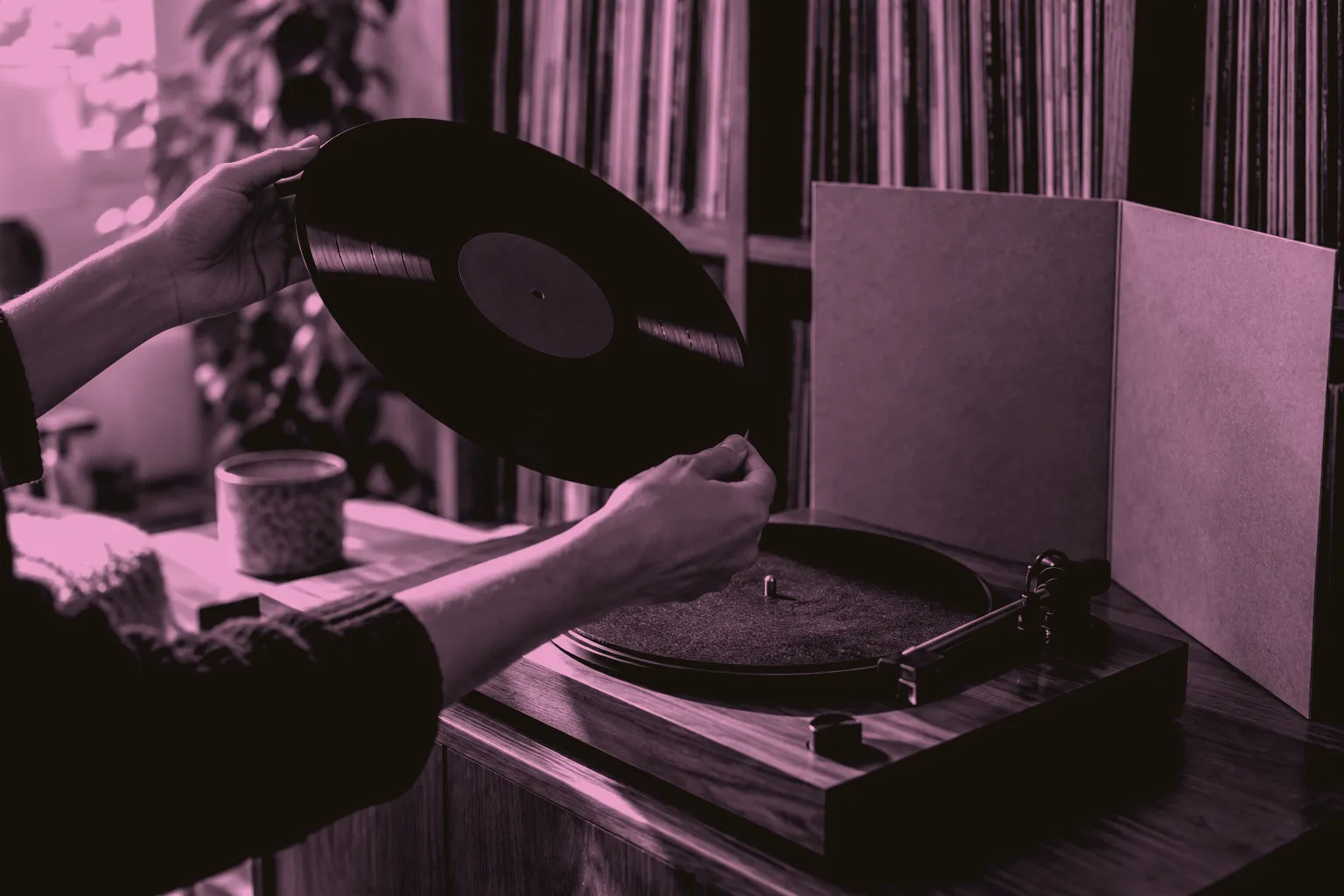
At the end of the first side of an LP there is a moment when the music stops and nothing happens until you get up. You lift the arm, turn the record over and put it back down. On most albums that pause is an interruption. On a few it is the point.
This list is ten albums that use the record itself: the break between the sides, the sleeve you hold while it plays, or a cut you can identify by a few letters scratched near the label. They are not the ten best albums ever made, and they are not chosen for what they might be worth. They are records where owning the vinyl gives you something the stream doesn’t.
For each one there is the copy to look for, with its catalogue number and a link to its release page on Discogs, so you can check the details before you buy. One of them, Abbey Road, has a full Perfect Albums entry with the story and selected editions; three more from the series follow the list.
What to look for on the record
Three things come up again and again below.
The sides. Some artists built their albums around the break between the sides: a suite that takes up a whole side, a side that runs without a gap, a last track hidden after a silence.
The sleeve. Twelve inches of card leaves room for things a CD booklet can’t hold: a working zip, folded posters, textured board with a photograph pasted on.
The cut. Before a record is pressed, an engineer cuts the music into a lacquer disc, and different editions of the same album can come from different cuts. The runout, the smooth band between the last groove and the label, can carry marks that identify the cutting engineer, the studio or the pressing plant. Read our guide to matrix numbers for what those marks can and can’t tell you. One name will recur here: Bernie Grundman, who was for years the in-house mastering engineer at A&M Studios in Hollywood, until he left in 1984 to start his own, and has since cut new editions of four of the albums on this list.
1. Miles Davis — Kind of Blue (1959)
Miles Davis recorded Kind of Blue in two sessions in New York, in Columbia’s 30th Street Studio, and the LP keeps them apart: the three pieces from 2 March 1959 make up side one, the two from 22 April make up side two. Two days, two sides, and settings Davis had sketched only hours before each session.
The record also has a flaw. Side one of every release before the 1992 remaster plays slightly off pitch, a speed error the remaster corrected, and this edition lets you hear it both ways. The 2025 Analogue Productions edition, APJ 8163, puts the first session on side A at the corrected speed and on side C at the original speed, so you can hear the record as it was bought for thirty years and as it was played in the room. Grundman cut it, and it was pressed at Quality Record Pressings in Kansas. It is a limited edition; once it is gone, the release page on Discogs is where to look.
If you want the record as it first appeared, the 1959 stereo LP is CS 8163 and the mono is CL 1355; their many versions on Discogs show how to tell the early labels apart. For nine more records that follow on from this one, the next album here among them, read the best jazz albums.
2. Bill Evans Trio — Waltz for Debby (1962)
Bill Evans, the pianist on most of Kind of Blue, recorded this album with Scott LaFaro on bass and Paul Motian on drums, live at the Village Vanguard in New York on 25 June 1961. Riverside released it the following year as six performances, three a side. Some CD editions slot alternate takes in between; this LP keeps the original six-track programme, with the room around the trio and nothing added.
The first US stereo pressing is Riverside RLP 9399, with “RLP-12-9399-A” in the runout, as its release page on Discogs shows; the mono is RLP 399, and the list of versions sets out the many pressings that followed. For a new copy, the 2023 LP from Craft Recordings, CR00617, was mastered from the original tapes in an all-analogue chain by Kevin Gray, who also cut it; look for “KPG@CA” in the runout. It was pressed at RTI; see the release on Discogs.
3. John Coltrane — A Love Supreme (1965)
John Coltrane recorded A Love Supreme in a single session on 9 December 1964, in Englewood Cliffs, New Jersey, at Van Gelder Studio. McCoy Tyner played piano, Jimmy Garrison bass and Elvin Jones drums. It is a suite in four parts, and the LP gives each side two of them: “Acknowledgement” and “Resolution”, then “Pursuance” and “Psalm”. The gatefold prints Coltrane’s own devotional poem, and on “Psalm” he plays its words on the saxophone without speaking them, so the sleeve puts the text in your hands while the music reads it out.
The 1965 stereo original is Impulse! AS-77, in a laminated gatefold; Rudy Van Gelder recorded it, and his name is in the runout of early copies, as the release page on Discogs shows. For a new copy, the 2020 LP, B0032077-01, made with Acoustic Sounds, was cut by Ryan K. Smith at Sterling Sound and pressed at Quality Record Pressings; its first run printed the wrong title for Part IV on the side two label, which the corrected pressing fixes. In 2025 Impulse! also reissued the mono mix, A-77, mastered by Smith from the analogue tapes; see the release on Discogs.
4. The Beach Boys — Pet Sounds (1966)
Brian Wilson recorded most of the instrumental tracks for Pet Sounds at United Western Recorders in Hollywood, with his usual engineer, Chuck Britz, and the voices of the Beach Boys layered on top. He mixed it in mono on purpose. Mono gave him control over how the record would sound on any system, and he was almost completely deaf in his right ear. No true stereo mix was released until 1997.
For Wilson’s original mix, choose mono. The 1966 US original is Capitol T 2458; copies pressed at Capitol’s Los Angeles plant carry an asterisk stamped in the runout, as the release page on Discogs explains. Be careful with DT 2458, the stereo sleeve from the same year: Capitol labelled it Duophonic, a fake stereo made from the mono with equalisation and phasing. For a new copy, the 2015 mono LP from Analogue Productions, APP 067M, was remastered and cut by Gray and pressed at Quality Record Pressings; its runouts read “KPG@CA QRP KEVIN GRAY”. See the release on Discogs.
5. The Beatles — Abbey Road (1969)
Side two of Abbey Road is mostly one piece. After “Here Comes the Sun” and “Because”, the Beatles run eight short songs and fragments together, from “You Never Give Me Your Money” to “The End”, in a medley of about sixteen minutes. Then, after fourteen seconds of silence, comes “Her Majesty”, which Paul McCartney had cut from the medley and which an engineer stuck back on the end of the tape.
Before you buy, decide which mix you want. The 1969 stereo mix is on the originals and on the 2012 LP. The 2019 anniversary editions carry a new mix by Giles Martin and Sam Okell, made from the original eight-track tapes. For the new mix, the 2019 LP, 0602577915123, was cut at half speed by Miles Showell at Abbey Road Studios; check for “MILES” and the half-speed inscription in the runout, as its release page on Discogs shows, because later pressings can differ. For the 1969 mix, look for a used copy of the 2012 LP, PCS 7088; its Discogs page shows the runout to expect.
For first-pressing details and selected editions, see our Abbey Road entry.
6. Marvin Gaye — What’s Going On (1971)
Marvin Gaye recorded most of What’s Going On in Detroit, at Motown’s Hitsville U.S.A. and Golden World studios, and it was the first record Gaye produced under his own name, and his first to credit Motown’s session players, the Funk Brothers. The songs follow a veteran coming home from Vietnam, and most run straight into the next, so a side plays with hardly a pause.
The 1971 US original is Tamla TS 310, a gatefold with the lyrics, the musicians’ credits and a “Family Photo Album” inside. The copy on its Discogs page has “dh” in the runout for its cutting engineer, Don Holden. For a new copy, Mobile Fidelity’s 2019 edition, UD1S 2-008, spreads the album over two discs at 45 rpm, cut by Krieg Wunderlich; its own notes say the transfer went from the analogue master through DSD to the lathe, so it is not an all-analogue chain, and the four sides break the flow in new places. See the release on Discogs.
7. Joni Mitchell — Blue (1971)
Joni Mitchell made Blue at A&M Studios in Hollywood over the winter of 1970 into 1971, with few other musicians: her voice with acoustic guitar, piano or the Appalachian dulcimer she had bought at a folk festival two years before. The engineer, Henry Lewy, kept things spare; James Taylor, who plays on several tracks, remembered him telling the musicians to keep it simple.
A record this quiet leaves the cut very little to hide behind. The 2022 LP, R1 2038, was newly remastered by Bernie Grundman under Mitchell’s supervision, according to its sticker, cut by Grundman and pressed at Optimal in Germany; his “BG” is in the runout. See its release on Discogs. The original is Reprise MS 2038, and the list of versions on Discogs separates the 1971 copies from the many later ones.
8. Pink Floyd — The Dark Side of the Moon (1973)
Pink Floyd made The Dark Side of the Moon at Abbey Road, then still called EMI Studios, with staff engineer Alan Parsons. Each side of the LP runs as one continuous piece, and a heartbeat opens and closes the album.
It also came with things to unfold. The gatefold, designed by Hipgnosis with the prism’s spectrum carried through to the inside, held two posters and two stickers. The 1973 UK original is Harvest SHVL 804; the master page on Discogs shows how to place a copy. For a new one, the 50th-anniversary LP from 2023, PFR50LP1, was remastered by James Guthrie, Joel Plante and Grundman, cut by Grundman, and still comes with the posters and stickers; see the release on Discogs.
9. Fleetwood Mac — Rumours (1977)
Fleetwood Mac recorded Rumours in 1976, starting at the Record Plant in Sausalito, where Ken Caillat and Richard Dashut engineered the sessions, while two couples in the band were breaking up. So much overdubbing wore out the Sausalito tapes that the drums went dull, and a specialist had to bring the damaged reels back into line with the safety copies before the album could be finished. Side two opens with “The Chain”, the one song all five members wrote together.
The 1977 US original is Warner Bros. BSK 3010, in a textured cover with an 11 × 22-inch fold-out insert of lyrics, credits and photographs. The copy on its Discogs page was mastered at Capitol and says so in the runout, beside the engineer’s initials, “KP”. For a new copy, the 2011 LP, 517786-1, was cut by Gray and Steve Hoffman at AcousTech, marked “KPG&SH@ATM” in the runout, and stayed in print after its first run; see the release on Discogs.
10. Steely Dan — Aja (1977)
Steely Dan used nearly forty session musicians across six studios to make seven songs, and the album won the Grammy for Best Engineered Recording. Its engineers, Roger Nichols, Bill Schnee and, on “Peg”, Elliot Scheiner, spent the sessions capturing that cast as cleanly as they could.
The original was mastered by Grundman at A&M: a 1977 US copy, ABC AA-1006, credits him, and the copy on its Discogs page was pressed at Specialty. He came back to it in 2023 for Analogue Productions’ 45 rpm UHQR edition, cut at his own studio from an analogue tape copy; see the release on Discogs. Geffen also released a standard LP in 2023, B0035028-01, cut by Alex Abrash at AA Mastering; its Discogs page lists the runouts. Missing multitrack tapes for “Black Cow” and the title track stopped a planned surround release in the late 1990s.
More from our Perfect Albums series
Four albums have a full Perfect Albums entry, with the story, selected editions and where to buy each one. Abbey Road is in the list above. The other three earn their place on vinyl for one reason each.
- Déjà Vu, by Crosby, Stills, Nash & Young, came in a brown textured gatefold with gold lettering and the band’s photograph pasted onto the front, a sleeve you notice with your fingers first. Read the Déjà Vu entry.
- Sticky Fingers, by the Rolling Stones, has the sleeve Andy Warhol conceived, with a real metal zip, which makes an early copy a record to inspect as well as grade. Read the Sticky Fingers entry.
- Transformer, by Lou Reed: in 2013, a few months before he died, Reed supervised a new remaster with Vlado Meller, and on its own it came out as a 2016 LP. Read the Transformer entry.
Choosing your copy
None of these needs a first pressing to be heard properly. What each needs is the programme you want, the mix and the running order, in a cut you can name, on a disc that plays quietly.
So before you pay, check three things against the listing: the catalogue number on the sleeve and the label, the marks in the runout, and the condition of the vinyl itself. Our guides to identifying a vinyl pressing and grading a record cover what to look at and how to read a seller’s description. If the edition you’re after is a reissue, our guide to originals, reissues and remasters explains what those words promise and what they don’t.
When the shelf starts to fill, Record by Record can keep the edition details of each copy, so the next listing can be checked against the one you already own.
Questions
Do these albums sound better on vinyl than on CD?
Not as a rule, and nothing on this page claims it. A good CD and a good LP of the same master can sound very close; a poor copy of either sounds poor. If you only want the sound at home, a well-mastered CD of the same album is a sensible choice.
Is a 180-gram pressing worth choosing over a standard one?
Weight alone tells you little. The weight does not identify the mastering, the lacquer cut or the pressing plant, which are what shape the sound of a copy. Several of the copies on this page are 180 grams because that is how they were made, not because the weight is the reason to buy them. Read the credits and the runout, and treat the weight as a detail.
Does a reissue keep the original side breaks?
Not always, so check the track listing of the exact edition. The 45 rpm Aja listed here spreads the album across two records, with "Deacon Blues" alone on side B. If the original sequence matters to you, and on several of these albums it is the point, compare the reissue's sides with the original's before you choose.
Why are there no prices on this page?
Because a price would go stale within weeks and would quietly turn a listening guide into a shopping list. The Perfect Albums entries linked from this page carry shop prices with the date they were checked. For used copies, the Discogs pages linked from each album show the releases; look at their sales history yourself, and compare condition, not just the number.
Sources
- en.wikipedia.org/wiki/Kind_of_Blue
- discogs.com/release/35666779
- discogs.com/master/5460
- en.wikipedia.org/wiki/Abbey_Road
- discogs.com/release/14186441
- discogs.com/release/4037087
- en.wikipedia.org/wiki/Déjà_Vu_(Crosby,_Stills,_Nash_%26_Young_album)
- en.wikipedia.org/wiki/Sticky_Fingers
- en.wikipedia.org/wiki/Blue_(Joni_Mitchell_album)
- en.wikipedia.org/wiki/Chaplin_Studios
- discogs.com/release/24747581
- discogs.com/master/47744
- en.wikipedia.org/wiki/Transformer_(Lou_Reed_album)
- legacyrecordings.com/2016/09/07/legacy-recordings-set-to-release-lou-reed-the-rca-arista-album-collection/
- en.wikipedia.org/wiki/The_Dark_Side_of_the_Moon
- discogs.com/release/28580086
- discogs.com/master/10362
- en.wikipedia.org/wiki/Aja_(album)
- discogs.com/release/3366636
- discogs.com/release/28749262
- discogs.com/release/28423303
- en.wikipedia.org/wiki/Waltz_for_Debby_(1962_album)
- discogs.com/master/104369
- discogs.com/release/13975220
- discogs.com/release/27345327
- en.wikipedia.org/wiki/A_Love_Supreme
- discogs.com/release/374507
- discogs.com/release/16026339
- discogs.com/release/19942006
- discogs.com/release/35229295
- en.wikipedia.org/wiki/Pet_Sounds
- discogs.com/release/1354479
- discogs.com/release/7093655
- en.wikipedia.org/wiki/What's_Going_On_(Marvin_Gaye_album)
- discogs.com/release/359107
- discogs.com/release/13044196
- en.wikipedia.org/wiki/Rumours_(album)
- discogs.com/release/13211318
- discogs.com/release/2832092
- discogs.com/release/1132195
- discogs.com/release/14246887
- discogs.com/release/7092674