Collecting guides
How to Display Vinyl Records Without Spoiling the Covers
Published
Ledges, frames, wall mounts and now-playing stands, weighed for dust and light: why the disc usually stays on the shelf, and how to keep records findable.
In short
- A ledge is the quickest display to change; a frame keeps dust out but is the slowest.
- For anything longer than an evening, show the jacket and keep the disc on the shelf.
- Light fades a cover for good; a UV-filtering frame slows the fading, but less light matters more.
- No cover should stay up for good: change what's on show when your listening changes.
- Leave a card in the empty slot saying where the record went, and remove it when it's back.
You bought some records partly for the cover, then filed them spine-out, where nobody sees it. The artwork is part of the pleasure of owning records, and on a shelf it only appears when you pull one out. Putting a few on show is simple: stand the jacket on a ledge, on a stand or in a frame, keep it out of the sun, change it often, and leave a card in the gap on the shelf.
Most of the detail comes down to one split. A cover is printed paper and card, and light fades it. A disc is vinyl, and heat warps it. So the cover goes on display, and the disc stays somewhere cool and dark.
Four ways to put a cover on show
Each way trades protection against how easily you can swap the record.
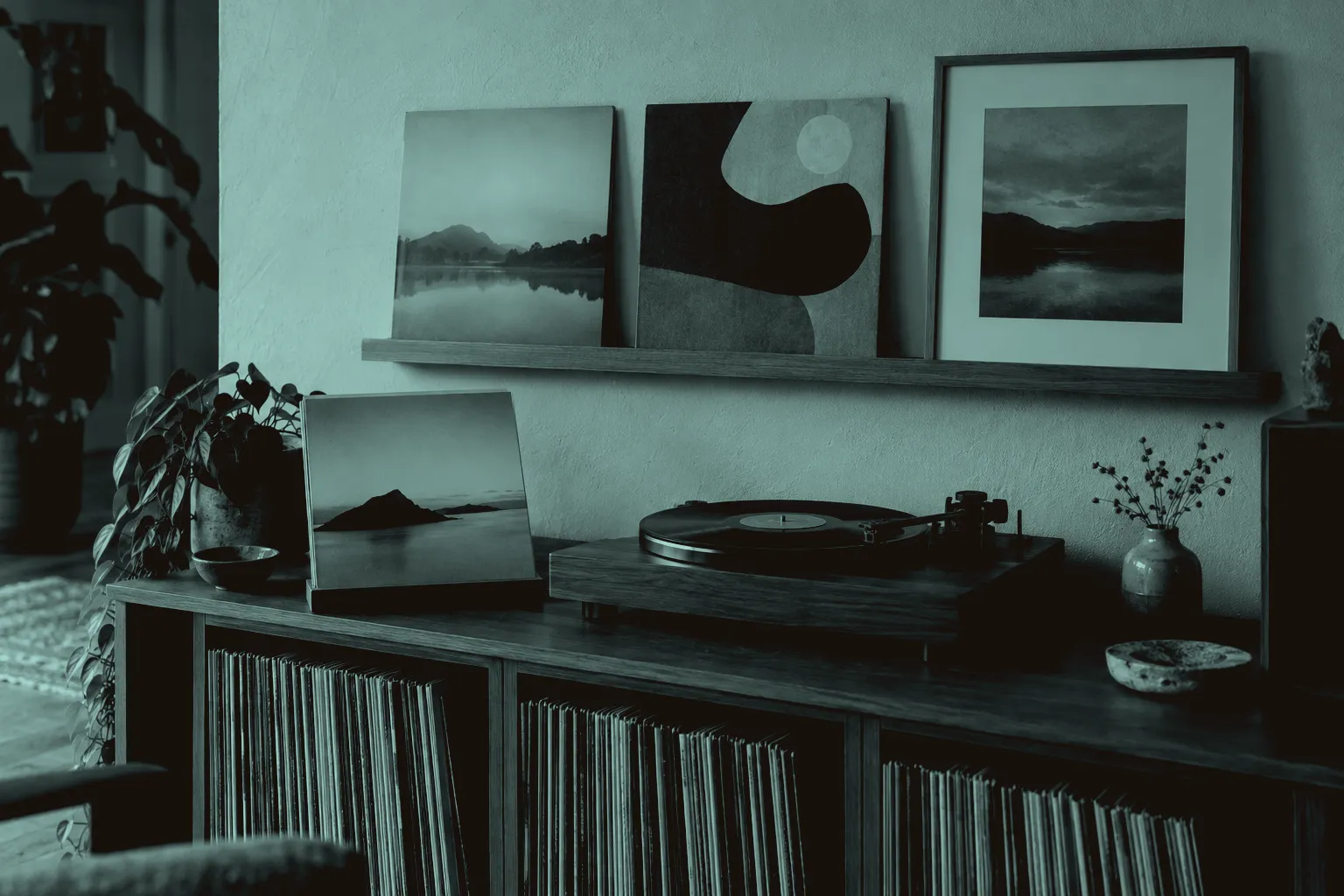
A picture ledge, or the front of a shelf compartment, is the quickest. The cover goes up in a second and comes down as fast. It also protects nothing: dust settles on it, light reaches it, and a ledge crowded with leaning records is the setup archivists warn about. Records are heavy, and the University of Illinois preservation guide notes that too many shelved at an angle without dividers can warp. One or two covers on a ledge is a display. Ten is a slumped shelf.
A frame is the opposite trade, and the slowest to change. The glazing — the glass or acrylic sheet at the front — and a sealed back keep dust out, and UV-filtering glazing cuts the ultraviolet share of the light. The cover must never touch the glazing, so a window mat or spacers keep a gap between them, and a gatefold or a thick jacket needs a deep frame. Measure the jacket you’re framing, gatefold included, rather than trusting a listed size.
A wall mount that holds a single jacket sits between the two. It’s nearly as quick to change as a ledge and just as open to dust and light, but no record leans on another.
A now-playing stand by the turntable holds the jacket of whatever is on the platter. It’s the one display where the cover is up only while the record plays, and both go back to the shelf together when you’re done.
The disc or just the jacket?
For an evening’s listening, it hardly matters. For anything longer, keep the disc in its inner sleeve on the shelf and put only the jacket on show.
No source gives a safe number of days for a record on display, so this is reasoning rather than a rule. A wall or a ledge usually gets more light and warmth than a packed shelf. Vinyl can soften and warp at high temperatures, which is why preservation guides say to keep recordings away from heat and light. Gilles St-Laurent’s guide for the National Library of Canada adds the part that makes it a slow problem: each cycle of warming and cooling leaves a small deformation in the disc that doesn’t go away, and the deformations add up. The shelf spares the disc all of that, and the wall loses nothing, since nobody can see a record inside its jacket anyway.
The now-playing stand is the exception, because there the disc is on the platter. Just don’t leave it bare beside the turntable between plays. Dust on a record can be pressed into the groove the next time it’s played, so when the side ends the disc goes back in its inner sleeve, held by the edge and the label.
Choose the wall before the frame
Where a cover hangs matters more than what it hangs in. Light damage to paper is, in the Northeast Document Conservation Center’s phrase, “cumulative and irreversible”. A faded cover put back in the dark stays faded, and a long spell in modest light does the same work as a short one in bright light.
Direct sun is the worst of it. Colours that fade can disappear, the Canadian Conservation Institute warns, “within as little as a few hours of direct sunshine”. For home collections, the Library of Congress asks for “minimal exposure to all kinds of light; no exposure to direct or intense light”, and for records to be kept away from radiators and vents. So not the wall opposite the window, and not the shelf above the radiator.
A UV-filtering frame is worth having, since ordinary glass and regular acrylic block little UV. It isn’t a licence for a sunny wall, though. Visible light fades printed colour too: for colours that fade easily, the CCI finds that UV is usually behind under half of the fading, and often as little as a tenth. Less light is what actually slows a cover’s fading, which is why conservators keep framed paper in subdued light even behind UV-filtering glazing. A clear plastic outer sleeve is the same story on a smaller scale: it keeps dust and fingers off and lets the light straight through.
If you light a display, use LEDs, which put no heat in the beam; halogen and incandescent lamps run hot and belong well away from the cover. Aim the light near the cover rather than straight at it. Avoid a damp, uninsulated outside wall, which can collect moisture. Choose a frame whose recessed back leaves a gap for air between it and the wall, and hang it securely.
Keep all this in proportion. It’s museum guidance, written for irreplaceable paper under exhibition lights. A cover on a shaded wall is not in danger by next week. A cover on a sunny one is fading a little every afternoon.
Rotate, and let the listening decide
Museums don’t leave paper on permanent display. They rotate it. For scale, NEDCC says most collection materials can be exhibited for three to four months at 50 to 150 lux without fading, and that 50 lux is similar to a living room in the evening. That’s a figure for controlled museum lighting, not a schedule for your hall, and a brighter room shortens it. We found no measured interval for record covers at home, so treat any “monthly” rule as a guess.
A habit tied to something that happens anyway works better than a calendar. Put up the record you’re playing this week. Give the latest arrival a turn before it’s filed. Change the wall with the season. No cover should stay up for good, and a display that changes when your listening changes never gets the chance. Wipe the ledge while it’s empty.
Keep the rest findable
A record on the wall leaves a gap on the shelf, and in six months the gap won’t say where the record went. When a record goes up, put a card in its slot saying where it is: “hall wall”, “by the turntable”. It’s the same device our guide to organising vinyl and CDs uses for box sets filed away from their artist, and it works for the same reason: the shelf tells you where to look. When the jacket comes back, the card comes out.
If you keep a catalogue, give the copy its display spot as a location while it’s up, and change it back when it returns. A location is only useful if it’s true.
A few covers, then, changed often and kept out of the sun, with the discs on the shelf and a card holding each place. If your collection lives in Record by Record, note where each copy is while it’s on the wall, and the shelf and the catalogue will still agree.
Questions
Should the shrink-wrap stay on a cover I'm displaying?
Take it off, on display or on the shelf. Gaylord, an archival supplies firm, warns that the wrap can keep shrinking after you buy the record, until it damages the record itself. If the wrap carries a sticker you'd like to keep, cut around it and keep the piece with the jacket.
I already have covers in ordinary frames. Should I reframe them?
Not in a hurry. Ordinary glass keeps the dust off, which is half of what a frame is for, even though it stops little of the UV. Moving the frame to a dimmer wall does more for the cover than new glazing on a bright one. When you next open the frame, check that nothing is pressed against the glass, and if you replace the glazing, choose a UV-filtering kind.
How do I display 7-inch singles or CDs?
By the same rules, at a smaller size. A picture sleeve on a single is printed paper and fades like an LP jacket, and a CD booklet is paper too, so the advice about sun, lamps and rotation holds for both. Small ledges and frames exist for each. On the shelf, keep the sizes apart, as our guide to organising a mixed collection explains, and leave a card in the gap as you would for an LP.
A cover on display has faded. Can it be restored?
No. Fading from light doesn't reverse, and putting the cover away in the dark only stops it getting worse. Return it to the shelf and choose a darker spot for the next one. If you ever describe the copy to someone else, remember that a sleeve carries its own condition grade, separate from the record's — a faded jacket with a clean disc is described as exactly that.
Can I display records on a wall that gets afternoon sun if I close the blinds?
Closing blinds or curtains during the brightest part of the day is what conservators recommend, and it helps. It doesn't turn a bright wall into a dim one, though, and the rest of the day's light still counts, because the damage adds up. If that's the only wall you have, keep each display there short, use UV-filtering glazing, and give the covers you care about most a darker spot.
Sources
- nedcc.org/free-resources/preservation-leaflets/2.-the-environment/2.4-protection-from-light-damage
- nedcc.org/free-resources/preservation-leaflets/2.-the-environment/2.5-protecting-paper-and-book-collections-during-exhibition
- nedcc.org/free-resources/preservation-leaflets/4.-storage-and-handling/4.10-matting-and-framing-for-works-on-paper-and-photographs
- canada.ca/en/conservation-institute/services/agents-deterioration/light.html
- loc.gov/preservation/care/record.html
- psap.library.illinois.edu/collection-id-guide/phonodisc
- clir.org/pubs/reports/child/sound/
- info.gaylord.com/resources/best-practices-for-vinyl-records