Collecting guides
How to Store Vinyl Records… So They Last
Published
Upright, supported, in polyethylene sleeves, on a shelf rated for the weight, in a steady room: how to store vinyl records at home so they last.
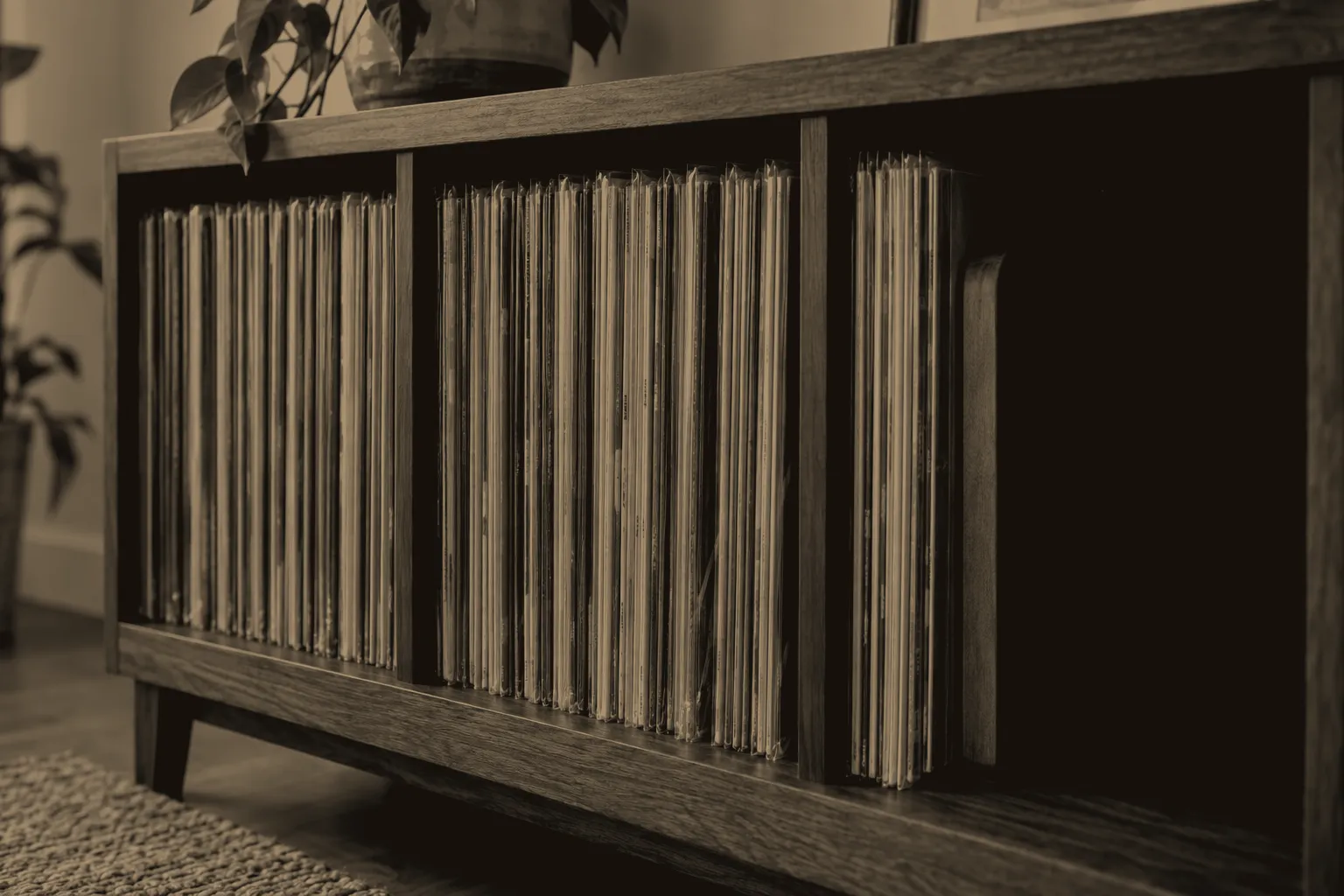
In short
- Vinyl itself is stable; what damages records at home is pressure, heat and dust.
- Store records upright between firm supports, never stacked flat or leaning in a half-empty row.
- A shelf of LPs weighs 35 pounds or more per foot, so check the shelf's rated load.
- Use polyethylene inner sleeves, never PVC, and take the shrink-wrap off.
- Keep records in a steady, cool, fairly dry room: not the loft, the garage or the cellar.
The records arrive faster than the shelf grows. A few wait in a stack by the turntable, two more lean at the end of a row that isn’t full yet, and the newest is still in its shrink-wrap. Most of that is fixable in an afternoon: stand the records upright and supported, in polyethylene inner sleeves, on a shelf built for the weight, in a steady room you would be comfortable in yourself.
The fix is that simple for a reassuring reason: of all the materials sound has been recorded on, vinyl is the most stable. A 1959 Library of Congress study by Pickett and Lemcoe reckoned that the chemical breakdown of a vinyl disc, in ordinary library conditions, should not set in within a century. What ruins records at home is physical: pressure, heat and dust. So storing them well is mostly a matter of geometry and climate.
Upright, supported, never stacked
A pile looks tidy and does the most harm. Every record in it carries the weight of the ones above, and pressure is what deforms a disc. Store records on edge, never flat.
A leaning row does the same damage more slowly. Records tilted at an angle press on each other unevenly, and a warp is not cosmetic: it shows up in the playing, not just on the shelf.
What prevents both is support across the whole face of each record. The Library of Congress asks for sturdy, fixed dividers every 4 to 6 inches (10 to 15 cm), each one holding up the whole face of the sleeved disc; further apart, the pressure turns uneven. Shelving divided into compartments does this for you. On an open shelf, use dividers or firm bookends, and move the last one up as the row grows, so a half-empty row never has room to slump.
How tight, then? Firm enough that nothing leans, loose enough that one record comes out on its own. No archive puts a number on it, and you don’t need one. A sleeve you have to prise out means too many records; a row that tilts when one leaves means too few.
Keep sizes apart as well. Larger discs filed among smaller ones lose support where the gap falls, and can warp. The guide to organising records and CDs on the same shelves covers sizes and filing order in full.
A shelf that carries the weight
Records are heavier than they look. LPs average 35 pounds or more per shelf-foot, about 16 kg for every 30 cm, by the Library of Congress’s count, and they load the middle of the shelf, which is enough to bring some shelving down. A fully loaded bookshelf, by one woodworking reference’s reckoning, weighs 20 to 40 pounds per running foot, so a full shelf of records sits at the heavy end of what bookshelves are built for.
Three things decide whether a shelf copes. The first is its rated load, which flat-pack furniture prints in its specifications: IKEA, for example, rates each shelf of its KALLAX unit at 13 kg. Weigh an armful of your own records on the bathroom scales, and the rating turns into a number of records you can picture.
The second is span, because sag grows much faster than length. A span a quarter longer sags twice as much, while doubling the thickness of the shelf cuts the sag to an eighth. A short, thick shelf will carry what a long, thin one of the same wood won’t.
The third is time. Wood keeps giving under a steady load, and an engineering rule of thumb puts the eventual sag at about half as much again as on the first day. A shelf that bows slightly when you fill it will bow more by next year.
Tall units should be fixed to the wall whatever they hold. The KALLAX page carries a tipping-hazard warning, and a unit full of records is a great deal of weight to tip.
Sleeves, inside and out
The inner sleeve is the only thing that touches the playing surface, so it matters most. Polyethylene is the material to use, high-density or soft, and a record should never sit in its jacket without an inner sleeve at all. If the original paper sleeve is printed with lyrics or photographs you want to keep, a thin polyethylene sleeve fits inside it: the disc touches plastic, and the printed sleeve stays with the record.
Plastic sleeves are not all alike. The archivist’s rule of thumb is that good ones look frosted and feel slippery, while bad ones are clear and slightly tacky. Whatever a sleeve feels like, one rule holds: never PVC, inside or out. As PVC ages, its plasticiser migrates into whatever it touches, faster under pressure, and can stain or damage it. Old sleeves of the wrong plastic can leave marks no cleaning removes, one of the things worth checking on a used record before you buy it.
Paper sleeves divide the experts. Preservation guides say ordinary paper is usually acidic and sheds fine dust and fibres onto the disc, and one says never to use paper or card inner sleeves at all. An archival supplier, which sells acid-free paper envelopes, counters that paper produces little static. Ordinary paper and archival paper are different things, and it is the ordinary kind the preservation guides warn about.
On the outside, a polyethylene, polypropylene or polyester outer sleeve keeps dust and scuffs off the jacket. It doesn’t block light, though, so it won’t stop a printed jacket fading in the sun.
Two habits finish the job. Take the shrink-wrap off, because it can go on shrinking for years, enough to warp the disc or damage the jacket. And when the side is over, put the record straight back in its inner sleeve and the sleeve back in its jacket. Dust caught between sleeve and disc gets pressed into the grooves, and dust holds the moisture mould feeds on.
A steady room, not a number
For a home collection, the Library of Congress asks for a cool, relatively dry, clean and stable room: room temperature or below, about 35 to 40% relative humidity, as little light as possible and none of it direct, away from radiators, vents and anything that vibrates. Look further and you’ll find other figures that don’t match, mostly because they were written for archives with climate control. Where they agree is the part that matters: cool, moderately dry and, above all, steady.
Steady matters because heat damage adds up. Vinyl is a thermoplastic: heat and pressure gave the record its shape, and heat softens it again. Each warm-and-cool cycle leaves a small, permanent deformation, and the next one adds to it. A room that stays slightly warm all year is kinder to records than one that swings between hot afternoons and cold nights. You will see warping temperatures quoted online; none of them comes from a library or archive, and they don’t agree with each other, so this guide gives none.
Damp is where the sources part company. A 1991 preservation report says vinyl resists mould and is unaffected by high humidity; the University of Illinois preservation guide says warm, humid conditions are prime ground for mould on vinyl discs. Either way, the paper is at risk. Damp encourages mould in recording collections, and the jacket and paper sleeve are the parts it spoils first.
Light is a smaller worry than it sounds. The Canadian Conservation Institute rates the overall risk of light damage to recording media as low, and a record left out for an afternoon is fine. Long exposure in the open is another matter, and direct sun brings heat as well as ultraviolet, both of which degrade vinyl. Keep the shelves out of the sun’s path.
Where not to keep them
Most bad places to store records are bad for the same reason: the climate swings, or water gets in. That rules out the loft or attic, the garage and, usually, the cellar or basement. Inside the living space it rules out the wall behind a radiator, the shelf by a heating vent, a sunny window, an outside wall, and the floor, which a leak, insects or mice reach first.
The basement deserves a second look rather than a flat no. The US National Archives points out that it is darker, cooler and steadier than the rest of the house, but humid unless a dehumidifier or air conditioning keeps it in check. If the basement has ever flooded, it says, choose another floor. More often the answer is a cupboard or a spare room, indoors. When records do come in from a garage or a cold storage unit, let them reach room temperature before you play them.
None of this needs special furniture. Upright, supported, sleeved in polyethylene, in a room you would happily sit in yourself: that covers nearly everything a record needs from you between plays. And if the collection now spans two rooms and a box in the spare room, note where each copy lives in Record by Record, so you know which record is in the box before you go looking.
Questions
How should I hold a record when I take it out?
By the edge and the label area only, never the playing surface. Let the disc slide out of its sleeve onto the flat of your hand, fingertips on the label and thumb on the rim, then take the opposite edge with your other hand. It feels fussy for about a week, and after that it is simply how you hold records. Put it away the same way, rather than resting it on the nearest flat surface while you find the jacket.
Is it all right to leave a record on the turntable between plays?
Better not. The University of Illinois preservation guide says never to leave a record in the playback machine, and to return it to its enclosure instead. On the platter it sits uncovered, gathering whatever settles out of the air, and the next play runs the stylus through all of it. Even if you mean to play the other side tonight, the few seconds it takes to sleeve the record are worth spending.
Can I keep records in boxes or crates instead of on shelves?
Yes, as long as the same rules hold. The records stand upright, and the box is full enough that none of them tilts; if it isn't, fill the gap with something firm. A closed, opaque box keeps light off the jackets, which an open shelf cannot do, and archival suppliers sell acid-free boxes made for records. Keep the box off the floor and out of the loft, the same as any shelf.
A record smells musty or has spots on it. What should I do?
Treat it as possible mould and keep it apart from the rest of the collection until you know. Handle it with care: the US National Archives notes that mould can be a health risk. Move it somewhere dry, look at the records that were stored beside it, and find out why that spot was damp, because cleaning one record does not fix the shelf it came from. Cleaning is a subject of its own.
Should I keep the disc outside its jacket to stop ring wear?
It is common advice, but we could not find a library or archive that says so. Ring wear is the pale circle a disc slowly rubs into its cover. The Canadian Conservation Institute's advice is simpler: disc in a soft polyethylene sleeve, then back in its original jacket. Some archives do keep acidic original covers apart from the disc, but that is institutional practice. For a collection you play, disc in jacket is the sensible default.
Sources
- loc.gov/preservation/care/record.html
- nedcc.org/assets/media/documents/Pres101/6_media_loc_c-cylinder_disc.pdf
- archives.gov/preservation/formats/audio-storage.html
- canada.ca/en/conservation-institute/services/preventive-conservation/guidelines-collections/caring-audio-video-data-recording-media.html
- psap.library.illinois.edu/collection-id-guide/phonodisc
- clir.org/pubs/reports/child/sound/
- info.gaylord.com/resources/best-practices-for-vinyl-records
- woodbin.com/calcs/sagulator/
- ikea.com/gb/en/p/kallax-shelving-unit-white-80275887/