Perfect Albums series
Lou Reed
TransformerThe story and the copies worth owning
Published
In short
- Transformer runs eleven songs without a weak one, made in little more than three weeks.
- David Bowie and Mick Ronson produced it at Trident Studios in London, in daytime sessions.
- Herbie Flowers played the bassline twice: double bass first, then electric bass on top.
- For a new LP, the 2016 RCA pressing carries the 2013 remaster Reed supervised himself.
- On CD, the 2002 remaster with two acoustic demos is the value pick.
Transformer had every reason to be a stopgap. Lou Reed’s first solo album had come out that spring and stalled at number 189 in America. So he went back to London and put himself in the hands of two Englishmen who revered his old band, one of whom later admitted the prospect petrified him. They worked in daylight because at night they were rehearsing their own show. The engineer was not sure how much of Reed was in the room. And the record they left behind runs eleven songs without a weak one, from the first chord of “Vicious” to the last sway of “Goodnight Ladies”.
What kind of record it is
On paper it is glam rock. In practice it is a New York record dressed for London: street portraits, Factory gossip and small love songs, played by a band that could switch from rock to cabaret to a pub singalong without changing expression. Classic Album Sundays hears cabaret, T. Rex-style rock, punk and ballads on the same two sides, and that is about right.
What holds it together is Reed’s voice, dry and conversational, telling you about people as if you might know them. The arrangements do the dressing up so he does not have to. “Perfect Day” has strings; “Make Up” has a tuba; “Walk on the Wild Side” has two basses and a saxophone. Reed barely raises his voice on any of them.
Not everyone was sold at the time. Reviewing it for Rolling Stone, Nick Tosches singled out “Satellite of Love”, “Vicious”, “Walk on the Wild Side” and “Hangin’ ‘Round” but thought Reed capable of far more dangerous music. Decades later, critic Tom Hull still read it as Reed trying to cash in on his producer’s glam. Listeners have mostly settled the argument the other way: Rolling Stone’s own list of the greatest albums placed it 109th in 2020.
Three weeks in London, mostly in daylight
David Bowie and his guitarist Mick Ronson had both been shaped by the Velvet Underground. Bowie had nodded to the band in the notes for Hunky Dory and was playing their songs on stage and on the BBC. In 1972 Bowie was riding high on Ziggy Stardust. Classic Album Sundays credits Reed’s label, RCA, with bringing the two together.
They recorded in August 1972 at Trident Studios in Soho, with Ken Scott, who had engineered Bowie’s Ziggy Stardust, at the desk. Ronson, still lead guitarist of the Spiders from Mars, did far more than co-produce: he played guitar, piano and recorder, sang backing vocals and wrote the string arrangements. The band around them was London session talent: Herbie Flowers and Klaus Voormann on bass, John Halsey, Barry DeSouza and Ritchie Dharma on drums, Ronnie Ross on baritone saxophone, and the vocal trio Thunderthighs.
Bowie and Ronson were rehearsing in the evenings for a show at the Rainbow Theatre, so the sessions were held in the daytime. Scott told Mix that the whole album took little more than three weeks, start to finish, and that the speed was part of why it worked.
Who ran those weeks depends on whom you ask. Bowie remembered Reed handing him the whole project. Flowers remembered Bowie turning up only once the tracks were down. Scott remembered Bowie away with Ronson much of the time and Reed present in body. The credits settle nothing: Bowie, Ronson, Scott, Reed and engineer Mike Stone are all listed on the mix.
The songs, and where they came from
- “Vicious” began as a commission from Andy Warhol. Reed told Rolling Stone that Warhol suggested a song called “Vicious”, and when Reed asked what kind, Warhol said: “Oh, you know, vicious like I hit you with a flower.” Reed took the line and built a sneer of a rock song around it.
- “Andy’s Chest” is older and stranger. Reed wrote it after Valerie Solanas shot Warhol in June 1968, and the Velvet Underground recorded it in 1969; that version stayed unreleased until VU in 1985. Here it is slower, with Flowers on bass and Bowie among the backing voices.
- “Perfect Day” is a day in Central Park with Reed’s then-fiancée, Bettye Kronstad. Ronson wrote the strings and played the piano, and in the Classic Albums film Reed praised the arrangement and the choice to keep his own vocal down so the strings could carry it.
- “Hangin’ ‘Round” is the album’s most straightforward glam rocker, and the one where Bowie’s hand is easiest to hear. The 2002 CD adds Reed’s acoustic demo of it.
- “Walk on the Wild Side” started as a song for a planned musical of Nelson Algren’s novel. When the musical was dropped, Reed kept the song and replaced Algren’s characters with people from Warhol’s Factory. Flowers played the line on double bass, then asked to add an electric bass above it, so the two slide in opposite directions. Ritchie Dharma played with brushes, Thunderthighs sang the “doo, doo, doo” that Scott worked to keep from getting boring, and the closing baritone sax is Ronnie Ross, who had given Bowie saxophone lessons when Bowie was a boy.
- “Make Up” is a song about cosmetics and coming out, carried by Flowers on tuba.
- “Satellite of Love” dates from 1970, when the Velvet Underground demoed it during the Loaded sessions and left it off. At the very end of this version Bowie’s harmony climbs far above everyone else’s, a moment Reed later singled out.
- “Wagon Wheel” is quick, plain rock ‘n’ roll; one review hears T. Rex in it.
- “New York Telephone Conversation” runs a minute and a half over a cheerful piano. Reed had been playing it with the Velvet Underground during their summer 1970 residency at Max’s Kansas City.
- “I’m So Free” is the other fast rocker on side two, and one of the songs the Classic Albums film stops to take apart.
- “Goodnight Ladies”, from the same Max’s residency, takes its refrain from T. S. Eliot’s The Waste Land. The 1998 CD booklet credits the arrangement and performance to Herbie Flowers “and some of his friends”: tuba, lazy jazz, closing time.
“Walk on the Wild Side”, paired with “Perfect Day”, was the first single. It reached number 16 in the US and number 10 in the UK, Reed’s only US Top 40 single. RCA sent radio stations an edited version; most played the original. “Satellite of Love” followed in February 1973 and “Vicious” in April. The album reached number 29 in the US and 13 in the UK.
In their own words
Bowie spoke about the sessions to PBS’s American Masters on 4 June 1997: “I was petrified that he said, yes, he would like to sort of work with me … because I had so many ideas and I felt so intimidated by my knowledge of the work that he’d already done.” He added: “But he just gave the whole project over to me, and I really hoped that I wouldn’t let him down.”
Herbie Flowers, talking to Bass Player in 2006, had a less reverent memory. Bowie, he said, “didn’t even show up until all the tracks were down.” Of the bassline itself: “There was no inspiration, just a bar of C and a bar of F going round and round.” And of his fee: “I got paid £12 for the session, end of story.”
Ken Scott, to Mix in 2008: “It was a strange time. David wasn’t around much, he was off with Rono rehearsing for the show, and I had no idea where Lou was. I mean, his body was there, but I’m not sure about the rest of him.”
Reed himself, writing in Between Thought and Expression, kept it plain: “They were going to make a musical out of Nelson Algren’s book A Walk on the Wild Side. When they dropped the project I took my song and changed the book’s characters into people I knew from Warhol’s factory.”
Three men, three memories of the same three weeks.
The sleeve
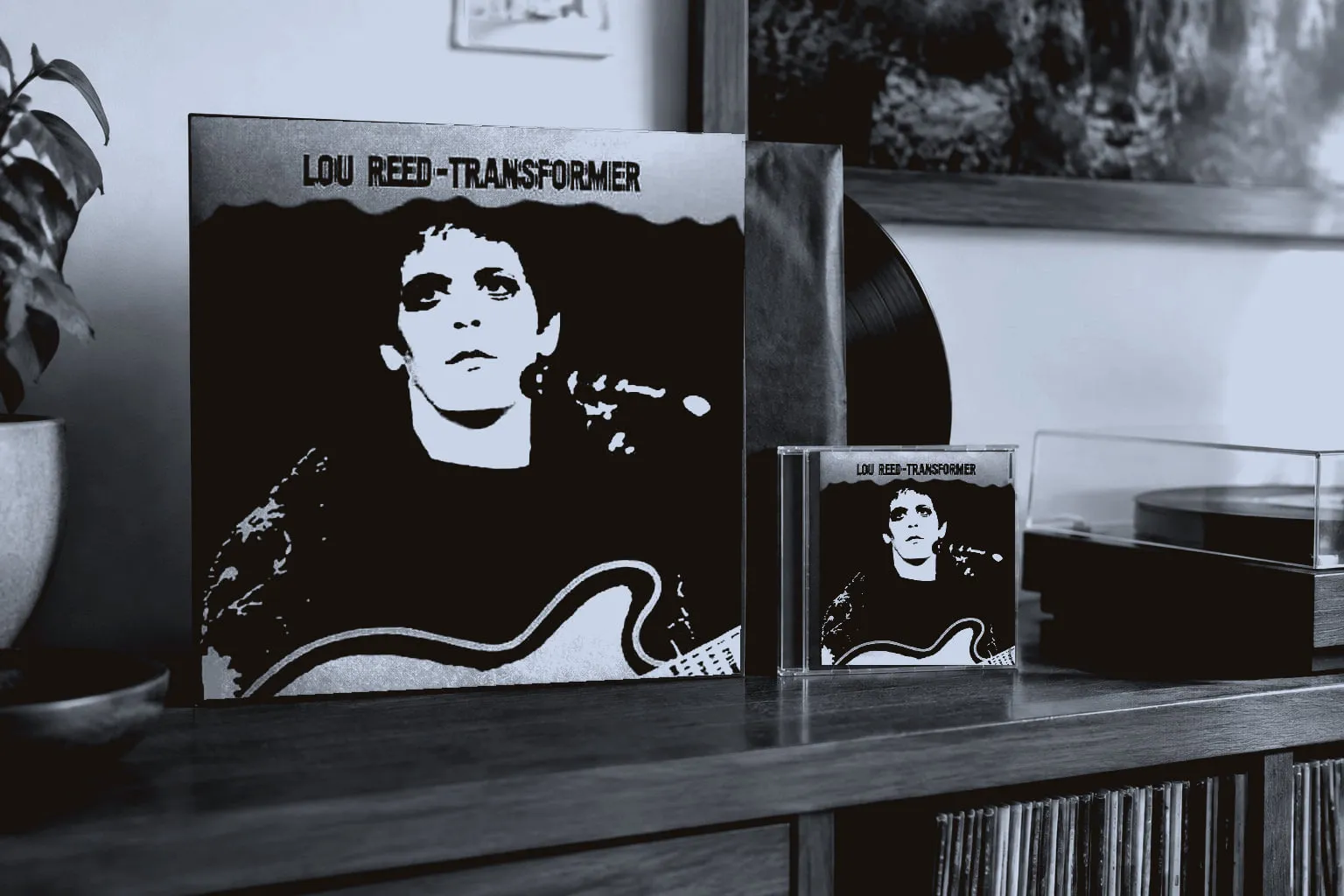
The front is a live photograph by Mick Rock, taken at Reed’s show at the Scala in King’s Cross, London, in mid-July 1972. It was never meant as a cover. Rock told Rock Archive that Reed went straight to it on the contact sheet, and that the frame was actually sharp: “the first pass on that one, it fell out of focus in the printing. I loved it when I saw it coming up.” Reed’s verdict was “That’s got to be the cover.” The soft, blown-out face is a darkroom accident, kept on purpose.
The back is in colour, by Karl Stoecker, who also shot the first three Roxy Music covers. It shows a woman, the 1960s model Gala Mitchell, and a man in tight jeans, Reed’s friend Ernie Thormahlen. According to Reed, the bulge that drew attention was a banana Thormahlen had put down his jeans before the shoot. Thormahlen is also credited with the sleeve’s art direction and design, so the man on the back designed the thing he appears on.
On a US first pressing, the sleeve was printed by Shorewood. Some US copies sent to radio carry a large white sticker on the front: “Please audition before radio airplay”, with the track list and timings. UK sleeves were printed by Clout & Baker, both matte and laminated, and some matte ones carry a misprint on the back: “Printed in Englana”.
Which copy to buy
Transformer has been pressed in many countries since 1972, and every edition below still credits the 1972 tape mastering by Arun Chakraverty. What differs is who cut the lacquer, and where it was pressed.
On vinyl
Shop prices were checked on 22 September 2026. For used prices, follow the Discogs link on each edition.
-
The 1972 US original, RCA Victor LSP-4807. Orange RCA Victor label with the Dynaflex name, matrix numbers BPRS-7038 and BPRS-7039 on the labels. At least three RCA plants pressed it, and the runout, the smooth area between the last groove and the label, tells you which: an “H” stamped for Hollywood, an “I” for Indianapolis, hand-etched numbers for Rockaway. A 1977 US reissue was renumbered AFL1-4807, and on some copies you can see the old BPRS number crossed out in the runout. If you want the record as America first bought it, this is the one. Used only: sales history on Discogs.
-
The 1972 UK original, RCA Victor LSP 4807. Pressed at RCA’s UK plant in Washington, with the same orange label and matrix numbers ending in 1E or 2E in the runout; sleeves are matte or laminated, as described above. We found no published comparison of the UK and US cuts worth repeating. Take it if the English sleeve, typo and all, matters to you. Used only: sales history on Discogs.
-
Speakers Corner, 180g, LSP-4807. A German reissue first released in 2004 and repressed since, with facsimile orange labels down to the Dynaflex logo. Speakers Corner says it was remastered “using pure analogue components only, from the master tapes through to the cutting head”; the lacquer was cut at Universal M&L in Germany and the record pressed at Pallas. If you want the analogue tape on a new, heavy record, this is it. New: JPC €36.99 in stock, Music Direct $41.99 in stock. Used: Discogs. One JPC buyer found it the equal of an original on sound but heard crackle after three plays, so buy where returns are easy.
-
The 2016 RCA reissue, 88985349031. The release carries the line “Remastered under Lou’s direct personal supervision”. According to Legacy Recordings, that remastering was done at Masterdisk in New York in June and July 2013 with engineer Vlado Meller, and finished shortly before Reed died that October. The lacquer was cut by Daniel Krieger at SST in Germany and the record pressed at MPO. Later coloured runs use the same cut: a white 50th-anniversary pressing for Record Store Day in 2022, and a black-and-white splatter for National Album Day in 2025. The last mastering Reed approved himself, and the sensible new copy. New: JPC €29.99 in stock, Music Direct $26.99 in stock; the splatter at JPC €32.99. Used: Discogs. One JPC buyer found it bass-heavy at first, then warm and full, and preferred it to his remastered CD.
Best value
-
Take the 2016 RCA LP on black vinyl. At €29.99 from JPC or $26.99 from Music Direct, it is the cheapest new LP on this page and the only one with Reed’s own approval on the mastering. Save the coloured pressings for when you want the object, not the sound.
-
The used route is a 1980s reissue. The US “Best Buy Series” pressing, AYL1-3806, has an orange logo in the top corner of the sleeve and was pressed at Indianapolis; its runout shows the older matrix numbers crossed out. It is not an original and does not pretend to be. The risk is condition, so read how to grade a record before you pay, and check the difference between an original, a reissue and a remaster if a seller is vague about which one you are looking at.
On CD
-
The 2002 remaster, RCA/BMG Heritage 07863 65132 2. Remastered by mastering engineer Vic Anesini at Sony Music Studios in New York, with the acoustic demos of “Hangin’ ‘Round” and “Perfect Day” added, a hidden radio advert for the album after the last demo, and a 16-page booklet. The tray card reads “Original Masters” down the spine. On CD, this is the value pick. New: JPC €11.99 in stock. Used: Discogs.
-
The 1998 remaster, RCA 74321 601812. Remastered by Andy Pearce at Masterpiece in London in July 1998, with liner notes by David Fricke. The album only, eleven tracks, and a booklet with photographs. It is the one to have if you want Transformer on a disc with nothing added. New: JPC €17.99, ships within a week if the supplier has it. Used: Discogs.
The first US CD, PCD1-4807 from 1986, was made by JVC and predates all of this; it turns up used on Discogs. The Masterdisk remaster Reed supervised came out on CD in the 17-disc RCA & Arista Album Collection box in 2016. Before buying any used disc, read the catalogue number and the mastering credit on the disc itself: our guide to buying used CDs shows where to look.
What to check on a used copy
Start with the runout: BPRS-7038 and BPRS-7039 with a plant letter mean a 1972 cut; AFL1 or AYL1 means a later US reissue. Matrix numbers explains how to read them. On a UK copy, look for 1E or 2E after the matrix. Then the sleeve: the black front shows every scuff and every trace of ring wear. Our pressing identification guide walks through the rest of the method.
When you have your copy, log the exact edition in Record by Record: catalogue number, plant, year. The next time someone offers you a “first pressing”, you will know what you are comparing it against.
Questions
Who are the people in "Walk on the Wild Side"?
Real people from Andy Warhol's Factory, under the names they used there. Holly Woodlawn came from Miami; Candy Darling came from Long Island; Little Joe is Joe Dallesandro, the actor in Flesh; Sugar Plum Fairy is Joe Campbell, from My Hustler; Jackie is Jackie Curtis.
Is "Perfect Day" about heroin?
Some commentators heard it as a song about heroin, which helped put it on the Trainspotting soundtrack in 1996. Reed disagreed. In a 2000 interview he said the reading was not true, that he did not mind it, and that the song's idea of a perfect day was the girl and sangria in the park. The day it describes was spent in Central Park with Bettye Kronstad, who later became his first wife.
Why is there a Velvet Underground version of "Satellite of Love"?
Reed wrote it in 1970, while he was still in the band, and they demoed it during the sessions for Loaded. The demo did not make the album and stayed unheard until the 1995 box set Peel Slowly and See, with lyrics that differ from the Transformer version. Hearing the two side by side shows how far Bowie and Ronson moved it, down to Bowie's high harmony at the end.
Is there a film about how Transformer was made?
Yes. The Classic Albums series made a Transformer episode in 2001, released on DVD by Eagle Vision. It has interviews with Reed, Bowie's recollections, rare Velvet Underground footage and appearances from Holly Woodlawn and Joe Dallesandro. It shows how the "Walk on the Wild Side" bassline was recorded, and plays Bowie's backing vocals on their own, without the band.
How did Transformer do after Lou Reed died?
Reed died on 27 October 2013. In the days that followed, digital sales of Transformer, "Walk on the Wild Side" and "Perfect Day" each rose by more than 300 percent, and "Walk on the Wild Side" entered Billboard's new Rock Digital Songs chart at number 38. The album is certified platinum in the UK and Italy, and gold in Denmark and France.
Sources
- en.wikipedia.org/wiki/Transformer_(Lou_Reed_album)
- en.wikipedia.org/wiki/Walk_on_the_Wild_Side_(Lou_Reed_song)
- en.wikipedia.org/wiki/Perfect_Day_(Lou_Reed_song)
- en.wikipedia.org/wiki/Satellite_of_Love
- en.wikipedia.org/wiki/Vicious_(Lou_Reed_song)
- en.wikipedia.org/wiki/Andy's_Chest
- en.wikipedia.org/wiki/Lou_Reed_(album)
- en.wikipedia.org/wiki/Herbie_Flowers
- en.wikipedia.org/wiki/Ronnie_Ross
- en.wikipedia.org/wiki/Classic_Albums
- mixonline.com/recording/classic-tracks/classic-tracks-lou-reeds-walk-wild-side-366039
- yahoo.com/entertainment/music/articles/david-bowie-didn-t-even-144045181.html
- pbs.org/wnet/americanmasters/archive/interview/david-bowie/
- davidbowie.com/2001/2001/12/21/bowie-on-transformer-documentary-broadcast
- classicalbumsundays.com/album-of-the-month-lou-reed-transformer/
- ultimateclassicrock.com/lou-reed-transformer/
- treblezine.com/lou-reed-transformer-review/
- rockarchive.com/prints/l/lou-reed-lour004mr
- legacyrecordings.com/2016/09/07/legacy-recordings-set-to-release-lou-reed-the-rca-arista-album-collection/
- speakerscornerrecords.com/products/details/4807/lou-reed-transformer
- audaud.com/lou-reed-transformer-speakers-corner-records/
- discogs.com/master/44278
- discogs.com/release/727363
- discogs.com/release/6566128
- discogs.com/release/8624284
- discogs.com/release/383995
- discogs.com/release/17739601
- discogs.com/release/6748740
- discogs.com/release/3660972
- discogs.com/release/2257653
- discogs.com/release/2684932
- discogs.com/release/15646371
- discogs.com/release/14246887
- discogs.com/release/11224185
- discogs.com/release/24975079
- discogs.com/release/35401441
- discogs.com/release/2425186
- discogs.com/release/1206817
- discogs.com/release/376296
- discogs.com/release/1385151
- jpc.de/jpcng/poprock/detail/-/art/Lou-Reed-Transformer-180g/hnum/8862479
- jpc.de/jpcng/poprock/detail/-/art/lou-reed-transformer/hnum/7853013
- jpc.de/jpcng/poprock/detail/-/art/lou-reed-transformer/hnum/12464452
- jpc.de/jpcng/poprock/detail/-/art/Lou-Reed-Transformer-Upgraded-Version/hnum/6955757
- jpc.de/jpcng/poprock/detail/-/art/Lou-Reed-Transformer/hnum/7160294
- musicdirect.com/music/vinyl/lou-reed-transformer-180g-import-vinyl-lp/
- musicdirect.com/music/vinyl/lou-reed-transformer-vinyl-lp/