Perfect Albums series
The Rolling Stones
Sticky FingersThe story behind the album and the copies worth owning
Published
In short
- Sticky Fingers runs ten songs without a weak one, begun in Alabama four days before Altamont.
- The first Stones studio album without Brian Jones, Sticky Fingers was also the first on their own label.
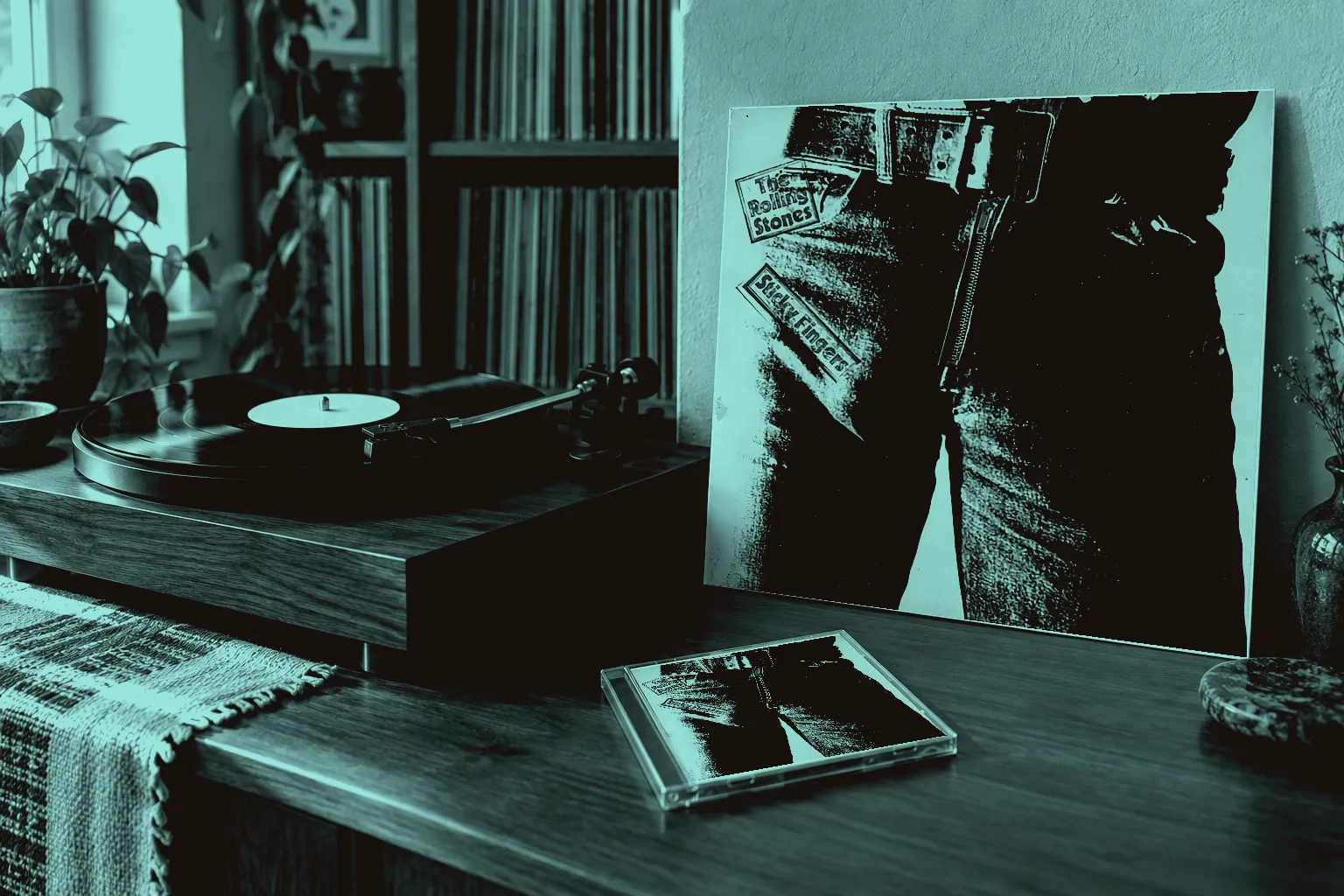
- Andy Warhol had the idea for the sleeve: tight jeans with a working zip.
- The 2020 half-speed is the only Sticky Fingers LP in print, but some owners find it quiet and flat.
- On CD, the 2009 remaster is the sensible buy; the 2015 deluxe adds a disc of extras to it.
Sticky Fingers had no business being this good. Brian Jones was dead: this would be the Rolling Stones’ first studio album without him. They were leaving their label, Decca, and their manager, Allen Klein, only to find they had signed their 1960s American copyrights over to him. Over three evenings in Alabama they cut “Brown Sugar” and “Wild Horses”. Two days after the last evening, they played Altamont. Then legal wrangling kept both songs off the shelves for more than a year. The record that finally appeared on 23 April 1971 runs ten songs without a weak one, from the riff that opens “Brown Sugar” to the strings that close “Moonlight Mile”.
What kind of record it is
Mostly a return to basics: drums, guitars, bass and percussion from the five members. On paper that makes it hard rock, roots rock and rock and roll, but inside those labels it roams: a traditional spiritual, a Stax-style soul ballad, a country song sung half as a joke, a jam that turns Latin, and a closing piece with strings.
Guests add the colour: Bobby Keys on saxophone, Billy Preston on organ, Ry Cooder on slide guitar, and Paul Buckmaster arranging the strings.
It is Mick Taylor’s first full studio album with the band, and the first on the band’s own label, Rolling Stones Records. Taylor, who joined in July 1969, had played on a whole Stones album only once before: the live Get Yer Ya-Ya’s Out!.
Three nights in Alabama, then a house in Hampshire
On 2 December 1969, during a break in an American tour, the band went into Muscle Shoals Sound Studio in Sheffield, Alabama. Their producer, Jimmy Miller, never made it; Jimmy Johnson, of the studio’s own rhythm section, engineered instead. Over three evenings they cut basic tracks and live vocals for three songs: “You Gotta Move” on 2 December, “Brown Sugar” on 3 December and “Wild Horses” on 4 December.
On 6 December, two days after the last session, they played “Brown Sugar” live for the first time at Altamont Speedway; Taylor had asked for the song. Then the Alabama songs sat: leaving Decca and Klein brought legal wrangling, and none of the three came out for more than a year. In the end Klein kept a share of “Brown Sugar” and “Wild Horses”, which remain the only two songs on the album the Stones co-own with his company, ABKCO.
Work on the rest of the album began in earnest in March 1970. Much of it was made at Stargroves, the manor house in Hampshire that Mick Jagger bought that year. The band recorded there with the Rolling Stones Mobile Studio, a control room built into a truck. It was the idea of pianist and road manager Ian Stewart. The rest was done at Olympic Studios in London, with Miller producing.
The songs
- “Brown Sugar” began in Australia, where Jagger wrote it while filming Ned Kelly, working an injured hand back into shape on a new electric guitar. It was cut at Muscle Shoals on 3 December, with Keys on the tenor saxophone solo and Stewart on piano.
- “Sway” was the first song recorded at Stargroves. Taylor plays the slide solo and the long one at the end. Jagger plays rhythm, his first electric guitar on a record, while Keith Richards sings but plays no guitar. Taylor later said he deserved a writing credit here and on “Moonlight Mile”; both are credited to Jagger and Richards.
- “Wild Horses” began as a lullaby Richards was writing for his newborn son, on a twelve-string in open tuning. At Muscle Shoals, Stewart refused the tack-piano part because he disliked the minor chords. Jim Dickinson, a Memphis session player who had dropped by, played it instead.
- “Can’t You Hear Me Knocking” opens on a Richards riff in open G, then runs into a Latin-tinged jam that nobody planned. “We didn’t even know they were still taping,” Richards said, and Taylor tells it the same way. Keys takes the saxophone solo, Preston the organ.
- “You Gotta Move” is a traditional spiritual the band learnt from Mississippi Fred McDowell’s 1965 recording. They cut it on 2 December, the first night in Alabama. The album named no songwriter; later issues added a credit.
- “Bitch” opens side two and dates from October 1970. Richards arrived late, barefoot, with a bowl of cereal, as engineer Andy Johns remembered it, then picked up his clear Dan Armstrong guitar and kicked the song up in tempo.
- “I Got the Blues” is a slow soul ballad in the Stax manner, with horns and a Hammond organ solo by Preston.
- “Sister Morphine” is the oldest song here, cut in March 1969 during the Let It Bleed sessions, with Cooder on slide. Marianne Faithfull co-wrote it and released it first, as a Decca B-side on 21 February 1969. Her name was left off Sticky Fingers; the credit was restored after a legal fight and acknowledged on the 1994 Virgin reissue.
- “Dead Flowers” is the album’s country song, recorded at Olympic in April 1970.
- “Moonlight Mile” was the last song recorded, in late October 1970 at Stargroves: an all-night session for Jagger and Taylor, without Richards, with strings by Buckmaster.
“Brown Sugar”, backed with “Bitch”, was the lead single in April 1971. It reached number one in the US and number two in the UK. “Wild Horses” followed in the US only, with “Sway” on the B-side, and reached number 28. The album was the band’s first number one in both Britain and America, and spent 69 weeks on the Billboard 200.
In their own words
A quarter of a century on, Jagger was still puzzled by his own lyric for “Brown Sugar”. Going through the album song by song for Rolling Stone (14 December 1995), he said: “God knows what I’m on about on that song. It’s such a mishmash. All the nasty subjects in one go.” “Wild Horses” he shared out plainly: “Yeah, it was his melody. And he wrote the phrase ‘wild horses,’ but I wrote the rest of [the lyrics]. It’s one of the prettiest.” “Sister Morphine”, in his reading, is less about the drug than it sounds: “It’s about a man after an accident, really. It’s not about being addicted to morphine so much as that. Ry Cooder plays wonderfully on that.” And the country song was never meant straight: “I love country music, but I find it very hard to take it seriously… so I do it tongue in cheek.”
What Taylor brought, Jagger put in one line: “He was a very fluent, melodic player, which we never had, and we don’t have now.”
The question everyone asks about “Wild Horses” he had answered two years earlier, in his notes for the 1993 compilation Jump Back: “Everyone always says this was written about Marianne, but I don’t think it was; that was all well over by then. But I was definitely very inside this piece emotionally.”
For Richards, Alabama was the right place for “You Gotta Move”: “We’re down in Alabama, we’re in Muscle Shoals, we gotta cut some Fred McDowell stuff… If ever I’m gonna do it, it’s gotta be here,” he remembers in the documentary Muscle Shoals. The three evenings lived up to it: “I thought it was one of the easiest and rockingest sessions that we’d ever done.”
With no producer in the room, Jimmy Johnson at the desk found himself treated as one: “After a few takes of ‘Wild Horses,’ Jagger just looks up at me and says, ‘Is that it?’ – like I’m the producer or something,” he told BMI.
The sleeve
The idea was Andy Warhol’s: a close-up of a crotch in tight jeans, with a working zip that opens onto white briefs. Craig Braun designed it, and Warhol is credited with the photographs. Another Factory photographer is sometimes named, but Braun and people from the Factory say Warhol took the Polaroids himself.
Braun had doubts about the zip from the start: “I was afraid of the zipper.” His alternatives included a fold-out sleeve shaped like trouser legs. The zip went ahead anyway and did what he feared: retailers complained that in stacked shipments it dented the records. Reportedly it was then pulled down to rest over the centre label, where the damage was slight; Braun tells that fix as his own. A working zip was also costly; later issues printed a photograph of the jeans instead.
Who posed for the sleeve is still argued over. Asked in 1995 whether it was him, Jagger said: “No. It’s one of Andy’s … protégés is the polite word we used to use, I think.” At least four men from Warhol’s circle have been named over the years, two of them by their own account. Warhol never said.
The album also introduced the tongue and lips logo. John Pasche drew it in 1970, and Braun’s team redrew it from a grainy fax into the version still in use. Pasche also co-designed the sleeve Spain got instead, after Franco’s regime censored the original: a hand in a can of treacle, on an edition that swapped “Sister Morphine” for a live “Let It Rock”.
On a copy, look at the lettering first. On first pressings the title and band name sit small and at the top of the US sleeve, larger and on the left of the UK one. Then the zip: real metal or printed, where it rests, and whether the record behind it carries a mark.
Which copy to buy
Bob Ludwig remastered the album for Virgin in 1994, and Stephen Marcussen and Stewart Whitmore did it again for Universal in 2009. The 2015 anniversary editions reissue the 2009 work; they are not a new remaster.
On vinyl
Shop prices were checked on 24 September 2026. For used prices, follow the Discogs link on each edition.
-
The 1971 UK original, Rolling Stones Records COC 59100. Working metal zip, a sleeve open at top and bottom, and a photo-and-credits insert printed by Richard Davis Ltd. The runout, the smooth band between the last groove and the label, is stamped COC 59100 with A3 or A4, B3 or B4, and T.M.L., for The Mastering Lab, credited with the cut. The first UK labels have no “A Promotone N.V. Record” line: Promotone was founded only in September 1971, by the Discogs release notes, so copies with it came later. The sleeve as designed. The missing Promotone line is the quickest check for an early copy. Used only: sales history on Discogs.
-
The 1971 US original, Rolling Stones Records COC 59100. Working zip. The label rim reads “DIST. BY ATCO, DIV. OF ATLANTIC RECORDING CORP., 1841 B’WAY”, the mark of a first US pressing. Several plants pressed it; two letters at the end of the label’s matrix number name the plant: PR for Presswell, MO for Monarch, SO for Sonic, RI for Philips. A 1977 reissue, renumbered COC 39105, kept the working zip. The copy America bought in 1971, dated by its label rim and plant letters. Used only: sales history on Discogs.
-
The 2020 Abbey Road half-speed master, 0602508773143. 180g, cut at half speed by Miles Showell at Abbey Road Studios; the runout is etched “MILES.ABBEY ROAD ½ SPEED”. Pressed at MPO in France, with a printed inner sleeve. No source we read says whether the zip is real. The one LP of the album still in print. New: JPC €32.99, not in JPC’s warehouse on the day, with new stock on its way; Music Direct $29.99 in stock; back-ordered at Acoustic Sounds. Used: sales history on Discogs. Owners disagree on its sound; those who complain find it quiet and flat.
-
The 2015 180g LP, 376 482-1. Pressed at MPO, with “0602537648214 A/B” etched in the runout. The anniversary single LP, now a used buy. Not available new: JPC lists it as currently unavailable. Used: sales history on Discogs.
-
The 2015 deluxe 2LP, 376 484-4. Pressed at GZ Media in the Czech Republic, with a small metal zip on the outer sleeve. The anniversary vinyl with a bonus LP, also a used buy. Not available new: JPC lists it as currently unavailable. Used: sales history on Discogs.
-
The 1981 Mobile Fidelity half-speed, MFSL 1-060. Half-speed mastered from the original stereo master tape, says the back cover. Stan Ricker cut it at the JVC Cutting Center, and JVC pressed it in Japan. The zip is printed and embossed, not metal. The older audiophile route: a separate cut from the tape. Used only: sales history on Discogs.
Best value
-
On vinyl, the 2020 half-speed is the only new choice. Since owners are split on its sound, buy it where returns are easy.
-
The used route is a 1970s copy: the 1977 US reissue with its working zip, or a later UK pressing with the Promotone line. Neither is an original, and we found no source saying either sounds better than one. The risk is condition, so read how to grade a record before you pay.
-
On CD, take the 2009 remaster, €9.99 at JPC on the day. For €16.99, the 2015 deluxe 2CD adds a disc of extras to the same remaster.
On CD
-
The 2009 Universal remaster, 0602527015620 (EU). Mastered by Marcussen and Whitmore and made by EDC in Germany; the disc’s inner ring reads “MADE IN GERMANY BY EDC”. The standard CD, cheap and in stock. New: JPC €9.99 in stock. Used: sales history on Discogs.
-
The 2015 deluxe 2CD, 376 483-6. An eight-panel digipak with a 24-page booklet. The first disc is the 2009 remaster; its matrix carries the 2009 CD’s number. The second is bonus material, including five tracks recorded live at the Roundhouse in 1971. The album plus a disc of extras for little more than the plain CD. New: JPC €16.99 in stock. Used: sales history on Discogs. One owner found the first disc more open than their original LP, but advised turning the treble down a little.
-
The 1994 Virgin remaster, CDV 2730. Ludwig’s remaster, first issued as a Collector’s Edition CD with a miniature zip. The pressing Discogs lists here was made by EMI in Uden, with “MADE IN HOLLAND” on the disc. The earlier remaster, and the one that restored Faithfull’s credit. Used only: sales history on Discogs.
What to check on a used copy
The runout comes first. On a UK copy, COC 59100 with T.M.L. and no Promotone line on the label means an early pressing. On a US copy, read the two plant letters at the end of the label matrix; COC 39105 means the 1977 reissue. Matrix numbers explains how to read them, and our pressing identification guide walks through the rest. Then the sleeve: metal or printed zip, where it rests, and the vinyl underneath. On a CD, read the catalogue number and the inner ring; our guide to buying used CDs shows where to look.
When you have your copy, log the exact edition in Record by Record: catalogue number, plant, year. The next time someone offers you a “first pressing with the zip”, you will know what you are comparing it against.
Questions
What was Rolling Stones Records?
The band's own label, set up as their Decca contract ran out; Sticky Fingers was its first album. Marshall Chess, son of Chess Records founder Leonard Chess, ran it at first. On 1 April 1971 the band signed a five-album distribution deal with Atlantic. Decca was still owed one last single, so the band handed over "Cocksucker Blues", correctly assuming it would be refused.
Why did the Rolling Stones stop playing "Brown Sugar"?
In 2021 the band dropped it from the setlist of their US tour. Its lyrics touch on slavery, interracial sex and drugs, and Jagger had distanced himself from them a quarter of a century earlier. Asked about the song by Jann S. Wenner for Rolling Stone in 1995, he said: "I never would write that song now."
Did anyone release "Wild Horses" before the Stones?
Yes. The Flying Burrito Brothers put it out first, on their album Burrito Deluxe in April 1970, after Gram Parsons heard a demo. That was a full year before Sticky Fingers, while the Stones' own take from Alabama was still held back. Their version reached the shops only in April 1971.
How did critics receive Sticky Fingers in 1971?
With reservations at first. The early reviews found it modest by the band's standards (Robert Hilburn, Los Angeles Times) or full of "forced attempts at style and control" everywhere except "Moonlight Mile" (Jon Landau, Rolling Stone). The wider vote was warmer: second overall in the Village Voice Pazz & Jop poll, with Lester Bangs placing it first. In 2018 The Guardian's Alexis Petridis ranked it the band's best, for "the flawless 46 minutes of music here".
Is there a version of "Brown Sugar" with Eric Clapton?
Yes. On 18 December 1970, at Olympic in London, the band recorded an alternate take with Eric Clapton on slide guitar and Al Kooper on piano. It stayed in the vault for more than four decades and was finally released on the 2015 Deluxe editions of the album, alongside other alternate takes and live recordings from 1971.
Sources
- en.wikipedia.org/wiki/Sticky_Fingers
- en.wikipedia.org/wiki/Brown_Sugar_(Rolling_Stones_song)
- en.wikipedia.org/wiki/Sway_(Rolling_Stones_song)
- en.wikipedia.org/wiki/Wild_Horses_(Rolling_Stones_song)
- en.wikipedia.org/wiki/Can't_You_Hear_Me_Knocking
- en.wikipedia.org/wiki/You_Gotta_Move_(song)
- en.wikipedia.org/wiki/Bitch_(Rolling_Stones_song)
- en.wikipedia.org/wiki/I_Got_the_Blues
- en.wikipedia.org/wiki/Sister_Morphine
- en.wikipedia.org/wiki/Dead_Flowers_(Rolling_Stones_song)
- en.wikipedia.org/wiki/Moonlight_Mile_(song)
- en.wikipedia.org/wiki/Stargroves
- en.wikipedia.org/wiki/Rolling_Stones_Mobile_Studio
- en.wikipedia.org/wiki/Rolling_Stones_Records
- en.wikipedia.org/wiki/Craig_Braun
- rollingstone.com/feature/mick-jagger-remembers-92946/
- ultimateclassicrock.com/rolling-stones-muscle-shoals/
- theartofcoverart.substack.com/p/what-if-sticky-fingers-didnt-have
- discogs.com/release/3492494
- discogs.com/release/11272687
- discogs.com/release/451342
- discogs.com/release/5812988
- discogs.com/release/6188019
- discogs.com/release/4778915
- discogs.com/release/3753501
- discogs.com/release/15527003
- discogs.com/release/23880710
- discogs.com/release/7091295
- discogs.com/release/7084781
- discogs.com/release/1408465
- discogs.com/release/1793858
- discogs.com/release/7098337
- discogs.com/release/1128340
- jpc.de/jpcng/poprock/detail/-/art/the-rolling-stones-sticky-fingers/hnum/9870829
- jpc.de/jpcng/poprock/detail/-/art/the-rolling-stones-sticky-fingers/hnum/7229876
- jpc.de/jpcng/poprock/detail/-/art/the-rolling-stones-sticky-fingers/hnum/7229628
- jpc.de/jpcng/poprock/detail/-/art/Rolling-Stones-Sticky-Fingers-2009-Remastered/hnum/7946776
- jpc.de/jpcng/poprock/detail/-/art/the-rolling-stones-sticky-fingers/hnum/7229847
- musicdirect.com/music/vinyl/the-rolling-stones-sticky-fingers-half-speed-master-180g-vinyl-lp/
- store.acousticsounds.com/d/151137/The_Rolling_Stones-Sticky_Fingers-180_Gram_Vinyl_Record