Collecting guides
How to Ship Vinyl Records… So They Arrive as They Left
Published
Take the disc out of the jacket, hold it flat between stiff board, label the parcel plainly, and agree tracking and insurance with the buyer first.
In short
- Parcels are sorted by machine, so a record's safety comes from the packing, not the label.
- Take the disc out of its jacket, so it can't split the seams on the way.
- Hold the record between stiff board so it can't bend or move, with nothing crammed.
- Insurance won't replace packing: USPS refuses claims for scuffs on items that weren't properly wrapped.
- Before posting, agree with the buyer on tracking, insurance, the address and who carries the risk.
A record has sold. The buyer has paid, the listing says VG+, and the copy is on your table with nothing yet between it and the post. The short version of what happens next: take the disc out of its jacket, hold the record between stiff board so it can’t bend or move, seal and label the parcel plainly, and agree tracking and insurance with the buyer before it goes.
Almost all of that happens at your table, because nobody on the way will be careful on your behalf. Parcels are sorted by machine. USPS warns that a package goes through automated processing machines and shares space with others weighing up to 70 lb, and Royal Mail says its sorting machines occasionally damage packaging. A “fragile” sticker changes little on that journey. The packing changes everything.
On the marketplaces, what the machines do is the seller’s problem. “You are responsible for ensuring the item arrives safely,” as eBay’s help pages put it to sellers, and a buyer whose record arrives damaged or not at all can get their money back under its guarantee. Discogs, too, leaves packing and shipping to the seller.
So before anything else, look at the copy once more against its listing. eBay’s rule is that an item must arrive as described; if it arrives broken or damaged and the listing didn’t say so, the buyer can return it for a refund even when the seller doesn’t take returns. The buyer will check it the way any careful buyer does, and our guide to buying used vinyl shows what they’ll look at. Make sure the grade you wrote is one you’d accept yourself — how to read VG+ and Near Mint covers what each one promises.
Take the record apart
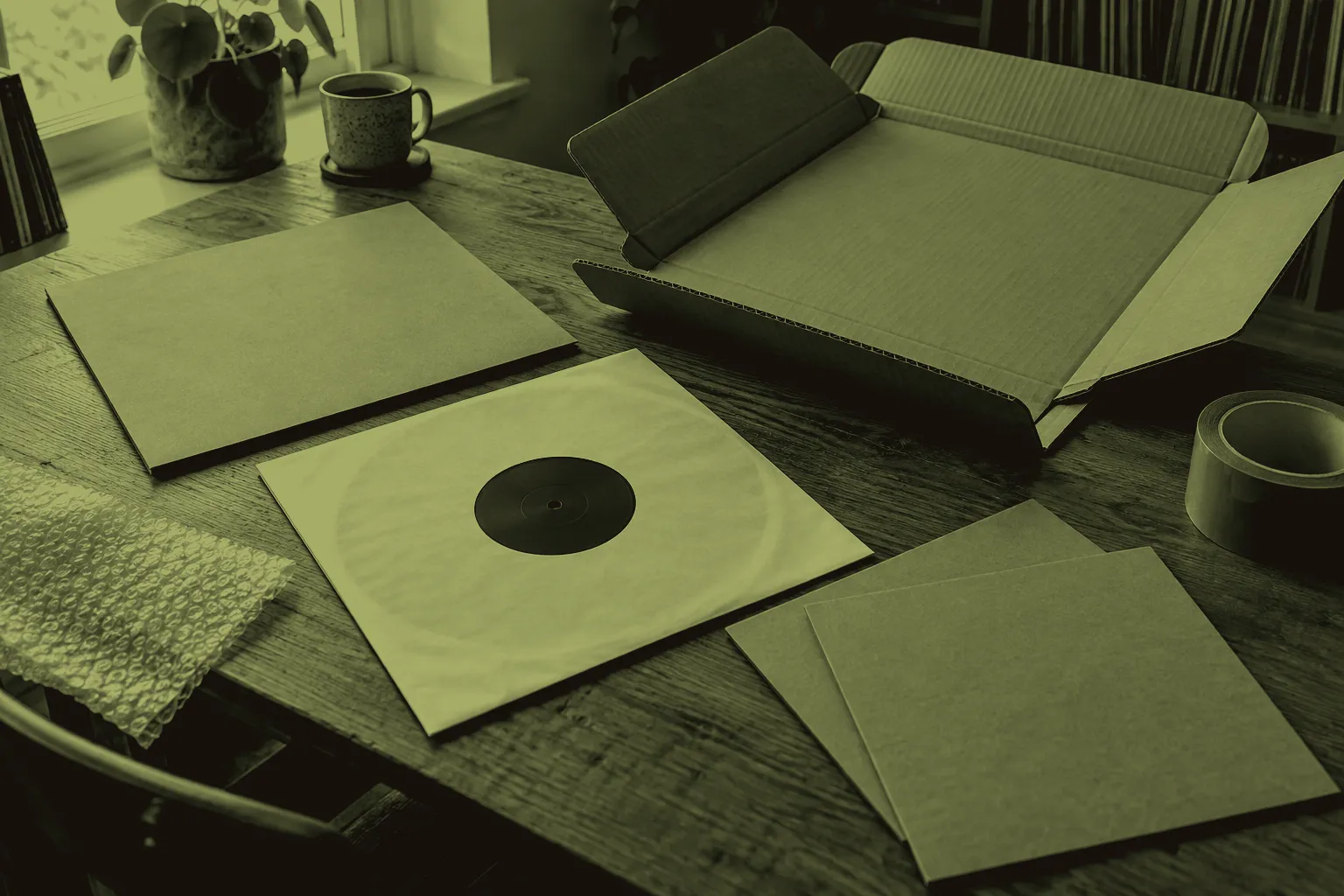
The first step surprises people: the disc comes out of the jacket. Discogs’s packing advice for sellers is to put the disc outside the jacket and slide everything, disc, jacket and inserts, into a plastic outer sleeve, which it says prevents seam splits and helps prevent scuffs. It’s marketplace advice rather than archive advice — no conservation source we found asks for it — but the reason it gives is the one that matters to a buyer opening the parcel.
The disc travels in an inner sleeve. If the one it lives in is the original, printed sleeve, Discogs suggests keeping it inside the jacket with the other fragile paper inserts and giving the disc a plain sleeve for the journey. A double album’s second disc goes on the other side of the jacket, so the jacket sits between the two discs.
While you’re there, replace any worn sleeves. Discogs suggests fresh inner and outer ones before shipping; it takes a few seconds, and the outer sleeve is the first thing the buyer touches.
A sealed copy is the exception, and it stays sealed. We found no carrier or marketplace guidance on this, so it’s our reasoning rather than a rule: opening it changes what was sold, and a buyer who paid for a sealed record is owed one.
Stiff on both sides
In a parcel, a record has two things to fear: bending and moving. Discogs recommends a folding cardboard mailer made for 12-inch records, with the record sandwiched between two cardboard inserts so it sits immobilised in the centre of the package. Australia Post’s advice points the same way for anything that could bend: a rigid mailer, or thick cardboard around the item before it’s packed. If the mailer flexes in your hands, add a sheet of stiff board to each side.
A box is the other honest answer. The carriers’ general advice for fragile things is a robust box, ideally double-walled, with at least 5 cm of cushioning around each item and nothing touching the sides, by Royal Mail’s standard. Discogs itself calls small boxes more reliable for CDs and cassettes, though they cost more to send. For a single LP the sources don’t pick a winner, and you don’t need one: either works if the record can’t bend and can’t move.
Nothing loose, nothing crammed
Inside, the record should neither slide nor strain. Choose a container slightly bigger than what goes in it, so there’s room to cushion every side, and fill the empty space until nothing shifts when you pick the parcel up and tilt it. Stop there, though. Royal Mail warns that overpacking can burst a box, and it counts balled-up newspaper and air pillows as poor cushioning.
Several records in one parcel need keeping apart, so they can’t knock against each other. Put a cardboard divider between them and hold each one as firmly as you would a single record.
Seal it and label it
Tape every seam with strong packing tape, the 2-inch-wide kind USPS asks for. Masking tape and clear household tape stay in the drawer, and string or twine stays off the parcel altogether, because USPS says it gets caught in sorting equipment.
A reused box is fine only if it’s sound and stripped of its history. Cover or remove every old label, barcode and address, since a visible old label can delay a parcel or send it back. Boxes also weaken in transit, which is why Royal Mail advises against reusing one for fragile items at all. And don’t send one carrier’s branded packaging with a different carrier.
The buyer’s address and the postage go on one side, with your return address in the top left of that same side, and the label lies flat rather than folded round an edge. Inside, add a slip with the buyer’s name and address and your own details, so the parcel can still find one of you if the outer label is torn off.
Then the question every first-time seller asks: should it say fragile? The sources disagree. Discogs tells sellers to write it, so the mail service knows what’s inside. Royal Mail says to use a fragile sticker if necessary. Australia Post says plainly that it doesn’t offer a “fragile” service, though it tries to handle items with care. Write it if you like; it costs nothing. But pack as though nobody will read it, because the sorting machines won’t.
Tracking and insurance are a choice
Tracking is the parcel’s diary: where it went, and the date and time it was delivered or delivery was attempted. How much of that diary you get depends on the service. Some of Royal Mail’s signed services are scanned only twice, when the parcel is received and when it’s delivered. A certificate of mailing is thinner still, proving only the date you handed the parcel over.
For a seller on a marketplace, that diary is protection. eBay says a seller who ships within the handling time and uploads tracking showing delivery isn’t responsible for refunding a buyer who says the parcel never arrived. For higher-value orders it also requires signature confirmation before that protection applies.
Insurance does a different job. You declare the cover; it pays the actual value of what’s inside, either as an option you buy or as a limited cover some services include, in some cases only when the parcel carries a tracking barcode. What insurance won’t do is replace packing. Under USPS’s rules, a claim isn’t paid for damage from shock without any damage to the box itself, for scuffs and scratches on an item that wasn’t properly wrapped, or for anything packed so that it couldn’t have arrived intact in the normal course of the mail. Royal Mail makes the same point more gently: pack it well, so your compensation isn’t affected.
If it comes to a claim, evidence decides it. Keep the postmarked receipt and proof of what the record was worth. A buyer reporting damage has to keep the box, all the packaging and the damaged record, and under USPS’s rules a claim without them is denied.
What to settle with the buyer first
Every one of these is easier to agree before the parcel goes than after it has gone missing. Put them in writing, in the marketplace’s messages if that’s where you sold:
- The service, how quickly it delivers and who pays the postage.
- Tracking and insurance, and who carries the risk without them. Discogs’s rule for its own marketplace is blunt: buyers and sellers who choose a method without tracking or insurance carry the risk themselves if the parcel is lost or damaged.
- The address, confirmed. The address on the marketplace and the one the payment provider holds can differ; if the buyer doesn’t reply, Discogs says to use the payment provider’s.
- One order, one parcel. Discogs asks for each order in its own parcel, so records bought separately that should travel together are best combined into one invoice before the buyer pays.
Across a border there’s paperwork as well. Many countries now want import tax information submitted digitally, often when you buy the label, and Discogs advises attaching the commercial receipt to the outside of the parcel so customs can see what tax was paid. Without it, the buyer may be charged VAT a second time, or the parcel held. What the buyer pays on arrival is their side of the sale.
When to post
Early in the week, if you can. NEDCC, a conservation lab that receives recordings by post, asks its clients to ship on a Monday, Tuesday or Wednesday so a parcel doesn’t spend the weekend in a warehouse, and to avoid major holidays and spells of extreme weather. That advice was written for shipments to a lab, but a sold record rides in the same vans and waits in the same depots. Heat is the particular worry. Plastics are adversely affected by heat, as a 1991 preservation report on the care of sound recordings put it, and a parcel posted into a heatwave spends its whole journey in one.
Pack for the machine, agree the rest in writing, and send the buyer the tracking number the day it goes. If the record is leaving your collection for good, deciding where to sell it is the decision before this one. Update your list of what you own the same day, in Record by Record or wherever you keep it, so the list and the shelf still agree.
Questions
The record arrived damaged. What should the buyer do?
Accept the parcel rather than refusing it, then photograph it before and after opening: the outer box, the packing and the record. Report it to the seller, or through the marketplace if that is where it was bought. eBay's guarantee, for instance, asks buyers to take delivery first and then report that the item isn't as described. Hold on to everything that came in the parcel until the claim is settled.
Can I post a record in a padded envelope?
It's the one choice the carriers' advice argues against. A padded envelope softens a knock but bends with the parcel, and bending is the damage a record mailer exists to prevent. For anything that might bend on the way, Australia Post points to rigid mailers or a layer of thick card first. If an envelope is all you have, the record isn't ready to post yet.
How do I send a 7-inch single or a box set?
The same way, scaled to the object. A 7-inch single wants a rigid mailer or box made for its size, not a 12-inch mailer with room to slide around in. A box set usually travels better in a box, each record held still, separated from the others with cardboard, and cushioned away from the walls. Treat the set's own slipcase as part of what you're protecting, not as the packaging.
Is there a US postal class just for records?
USPS has Media Mail, a class that accepts sound recordings among other media. It comes with conditions worth telling the buyer about: it has to be handed over at a Post Office counter, it isn't sealed against postal inspection, so sending it means consenting to the parcel being opened, and it has no guaranteed delivery time. Whether it suits a particular sale is one more thing to agree before posting.
Who pays if a record I post to a friend breaks?
Nobody, by default, unless the parcel was insured and a claim is paid. That makes a gift or a loan worth the same short conversation as a sale: tracked or not, insured or not, and whose loss it is if the record arrives in pieces. Pack it exactly as you would for a buyer. The sorting machines have no way of knowing it's a favour between friends.
Sources
- discogs.com/selling/resources/packing-and-shipping/
- support.discogs.com/hc/en-us/articles/4415351546381-How-To-Ship-An-Order-Internationally
- ebay.com/help/selling/posting-items/labels-packaging-tips/packing-sold-items?id=4156
- ebay.com/sellercenter/shipping/preparing-your-shipment/packaging-and-measuring
- ebay.com/help/policies/ebay-money-back-guarantee-policy/ebay-money-back-guarantee-policy?id=4210
- ebay.com/help/selling/selling/seller-protections?id=4345
- usps.com/ship/packages.htm
- usps.com/ship/insurance-extra-services.htm
- pe.usps.com/text/dmm300/609.htm
- pe.usps.com/text/dmm300/173.htm
- royalmail.com/help/sending/packaging-and-sending-fragile-items
- royalmail.com/help/postage-tracking-terms-explained
- auspost.com.au/sending/packaging/packing-hints-tips
- nedcc.org/audio-preservation/packing-and-shipping-audio-media
- clir.org/pubs/reports/child/sound/